I could not find any information about this book but it is a great book about psychology and is one of the few I've had to read for school that does not shame or put down people who have a mental disorder.
Showing posts with label Psychology. Show all posts
Showing posts with label Psychology. Show all posts
Sunday, April 24, 2016
What is projection?
- Psychological projection - Wikipedia, the free encyclopedia
- Psychological Projection: Dealing With Undesirable Emotions | Lifescript.com
- Psychological projection - RationalWiki
- Urban Dictionary: psychological projection
- Projection @ Changiing Minds
- 6 Examples of Psychological Projection We All Commit ⋆ LonerWolf
Tuesday, April 19, 2016
What is disinhibition / online disinhibition?
"In psychology, disinhibition is a lack of restraint manifested in disregard for social conventions, impulsivity, and poor risk assessment. Disinhibition affects motor, instinctual, emotional, cognitive, and perceptual aspects with signs and symptoms similar to the diagnostic criteria for mania. Hypersexuality, hyperphagia, and aggressive outbursts are indicative of disinhibited instinctual drives"
See more @Wikipedia
More Info...
See more @Wikipedia
More Info...
- Online Disinhibition Effect @ Encyclopedia of Psychology
- Disinhibition - The Definition and Examples
- Disinhibition definition | Psychology Glossary @ alleydog.com
- @NCBI
- Online disinhibition effect @ Wikipedia
Tuesday, September 29, 2015
“Tereska Draws Her Home” by David Seymour, 1948 @ Aphelis
"Tereska, a small girl at a special school for war-handicapped children recently constructed in Warsaw, Poland, was asked to draw her house and family. She produced this representation of her confused mind ― wavering chicken-track lines crisscrossing each other. What is it that she sees when the teachers say “draw a house”? Is it the memory of terror and the fact or ruins? Are not chicken-track lines of this little child’s drawing but the reflection of an uprooted life, the mirror of disorder and chaos which the war has strewn over Europe"

More Info..
Saturday, September 5, 2015
[Pic:] How to talk to someone with depression @ Bipolar support
Note: Tea IS relaxing, just don't say that to "cure" them.Offering them tea to show support is awesome!

TOP 10 SIGNS OF DEPRESSION @ General Health Blog
Being over-confident and fearless
Increased alcohol consumption
Sexual obsession or exercise
Anger issues
Suppressed feelings
Excessive socializing
Trouble accepting praise or goodwill
You work harder but not smarter
See explanations @ General Health Blog
Increased alcohol consumption
Sexual obsession or exercise
Anger issues
Suppressed feelings
Excessive socializing
Trouble accepting praise or goodwill
You work harder but not smarter
See explanations @ General Health Blog
Wednesday, September 2, 2015
Who is Matthew McKay , PhD
"Matthew McKay, PhD, is a professor at the Wright Institute in Berkeley, CA. He has authored and coauthored numerous books, including The Relaxation and Stress Reduction Workbook, Self-Esteem, Thoughts and Feelings, When Anger Hurts, and ACT on Life Not on Anger. He has also penned two fiction novels, Us and The Wawona Hotel. McKay received his PhD in clinical psychology from the California School of Professional Psychology, and specializes in the cognitive behavioral treatment of anxiety and depression. He lives and works in the greater San Francisco Bay Area."

@ New Harbinger
More Info...
@ New Harbinger
More Info...
Darwinian Happiness: Evolution As a Guide for Living and Understanding Human Behavior Bjørn Grinde
"Darwinian Happiness: Evolution As a Guide for Living and Understanding Human Behavior, ISBN 0-87850-159-2, is a 2002 book by the Norwegian biologist Bjørn Grinde from the Norwegian Institute of Public Health. He argues that human emotions find their cause in evolution and offers ways by which we can use this for our advantage.

More specifically, mammals are equipped with a nerve system that enables them to distinguish not only between pleasant and unpleasant sensations, but positive and negative experiences in general. While the biological term fitness refers to the capacity to create offspring, happiness (or quality of life) is, at least in a biological perspective, a question of the qualities of the experiences our nervous system offers us.
In order to improve these experiences there are two main principles to consider:
More specifically, mammals are equipped with a nerve system that enables them to distinguish not only between pleasant and unpleasant sensations, but positive and negative experiences in general. While the biological term fitness refers to the capacity to create offspring, happiness (or quality of life) is, at least in a biological perspective, a question of the qualities of the experiences our nervous system offers us.
In order to improve these experiences there are two main principles to consider:
Tuesday, September 1, 2015
Who is Bjørn Grinde
"Bjørn Grinde is a biologist working in the fields of genetics and evolution, with a particular interest in human evolution. He studied natural sciences as well as psychology and anthropology at the University of Oslo, resulting in a Dr.scient (1981) and a Dr.philos (1984) from the same university. Presently he works as a chief scientist at the Norwegian Institute of Public Health, associated with the Division of Mental Health]. Many of his scientific papers have focused on molecular evolution, using viruses as a model system.
A prime interest has been to use knowledge on human behavioral biology (also referred to as evolutionary psychology) to improve health and quality of life. His most known book, meant for a general audience, Darwinian Happiness was written for this purpose. He has also published several scientific papers on the topic. See his personal website at wikispaces for a list of key publications."
See more @ Wikipedia

Official site
A prime interest has been to use knowledge on human behavioral biology (also referred to as evolutionary psychology) to improve health and quality of life. His most known book, meant for a general audience, Darwinian Happiness was written for this purpose. He has also published several scientific papers on the topic. See his personal website at wikispaces for a list of key publications."
See more @ Wikipedia
Official site
Tuesday, August 11, 2015
What is Phrenology?
"Phrenology (from Greek φρήν (phrēn), meaning "mind", and λόγος (logos), meaning "knowledge") is a pseudoscience primarily focused on measurements of the human skull, based on the concept that the brain is the organ of the mind, and that certain brain areas have localized, specific functions or modules. Although both of those ideas have a basis in reality, phrenology extrapolated beyond empirical knowledge in a way that departed from science. Developed by German physician Franz Joseph Gall in 1796, the discipline was very popular in the 19th century, especially from about 1810 until 1840. The principal British centre for phrenology was Edinburgh, where the Edinburgh Phrenological Society was established in 1820.
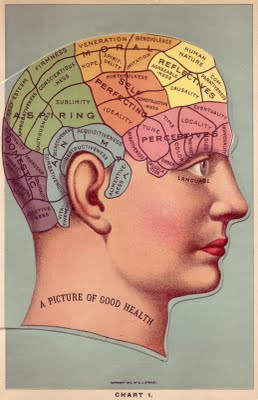
Although now regarded as an obsolete amalgamation of primitive neuroanatomy with moral philosophy, phrenological thinking was influential in 19th-century psychiatry. Gall's assumption that character, thoughts, and emotions are located in specific parts of the brain is considered an important historical advance toward neuropsychology."
See more @ Wikipedia
More info..
Although now regarded as an obsolete amalgamation of primitive neuroanatomy with moral philosophy, phrenological thinking was influential in 19th-century psychiatry. Gall's assumption that character, thoughts, and emotions are located in specific parts of the brain is considered an important historical advance toward neuropsychology."
See more @ Wikipedia
More info..
- Vintage Clip Art – Phrenology Head in Color
- phrenology: phrenological map of the brain
- Mind Games – A look at phrenology in the 1830s
- John van Wyhe, History & Philosophy of Science, Cambridge University
- phrenology (cranioscopy) @ Skeptic's dictionary
- What Is Phrenology? @ Stanford Hospital & Clinics
- What Is Phrenology? @ About
- Phrenology: History of a Pseudoscience by Steven Novella, MD
Wednesday, August 5, 2015
Sensitive (Mental) Health: What is the Relationship Between Borderline Personality Disorder (BPD) and High Sensitivity? from Comfort Zone Blog
I dislike when they stigmatize BPD a bit,but alas,this makes a good point.People who have BPD may be a HSP. there are many similarities.
"HSPs And Borderline Disorder
While the impulsivity and rages associated with BPD are far from the behavior of most sensitive persons, there are HSPs who do have this disorder. This is because HSPs are more affected than others by having a troubled childhood. But there are also many non-HSPs who receive this diagnosis. The trait itself and the disorder itself are very, very different. This is a fact as important for HSPs with the diagnosis as it is for HSPs without it. Those with the diagnosis have to keep in mind what might be normal for an HSP among all of their intense thoughts and emotions, and what is not.
Confusion has arisen because of course many times professionals meet HSPs who do also fit the BPD diagnosis. But sometimes mistakes are made, especially because all HSPs tend to be more emotional, and to those professionals who are non-HSPs and less emotional, this can seem abnormal. Since any abnormality that has been present throughout one’s adulthood and has impaired one’s life can be classified as a personality disorder, the next step is only deciding which personality disorder. Since those with BPD are often said to be “hypersensitive” to nonverbal communication, when professionals hear of “high sensitivity” they may think it is the same thing.
Adding to the confusion, some psychiatrists (e.g., Stone, Grotstein) say that “hyper irritability” is typical of BPD and can be either inherent or traumatically induced. If it really is inherent, that might seem to be the same as being an HSP. But I don’t see the evidence for BPD being inherited. They make an analogy to physical systems, arguing that the borderline’s sensitivity leads to a lowered threshold, exaggerated response, and chaotic oscillations. But if this over reactivity is inherited–which, again, I doubt--it does not seem likely to be the same innate trait as we are familiar with, which predominately involves a preference for reflection before action, is found in twenty percent of the population, and has persisted throughout the long course of evolution....
Don’t Worry, We All Are Borderlines Just a Little Bit
"HSPs And Borderline Disorder
While the impulsivity and rages associated with BPD are far from the behavior of most sensitive persons, there are HSPs who do have this disorder. This is because HSPs are more affected than others by having a troubled childhood. But there are also many non-HSPs who receive this diagnosis. The trait itself and the disorder itself are very, very different. This is a fact as important for HSPs with the diagnosis as it is for HSPs without it. Those with the diagnosis have to keep in mind what might be normal for an HSP among all of their intense thoughts and emotions, and what is not.
Confusion has arisen because of course many times professionals meet HSPs who do also fit the BPD diagnosis. But sometimes mistakes are made, especially because all HSPs tend to be more emotional, and to those professionals who are non-HSPs and less emotional, this can seem abnormal. Since any abnormality that has been present throughout one’s adulthood and has impaired one’s life can be classified as a personality disorder, the next step is only deciding which personality disorder. Since those with BPD are often said to be “hypersensitive” to nonverbal communication, when professionals hear of “high sensitivity” they may think it is the same thing.
Adding to the confusion, some psychiatrists (e.g., Stone, Grotstein) say that “hyper irritability” is typical of BPD and can be either inherent or traumatically induced. If it really is inherent, that might seem to be the same as being an HSP. But I don’t see the evidence for BPD being inherited. They make an analogy to physical systems, arguing that the borderline’s sensitivity leads to a lowered threshold, exaggerated response, and chaotic oscillations. But if this over reactivity is inherited–which, again, I doubt--it does not seem likely to be the same innate trait as we are familiar with, which predominately involves a preference for reflection before action, is found in twenty percent of the population, and has persisted throughout the long course of evolution....
Don’t Worry, We All Are Borderlines Just a Little Bit
Tuesday, August 4, 2015
Monday, August 3, 2015
Wednesday, July 29, 2015
Watch THX 1138
"THX 1138 is a 1971 science fiction film directed by George Lucas in his feature directorial debut. The film was produced by Francis Ford Coppola and written by Lucas and Walter Murch. It stars Robert Duvall and Donald Pleasence and depicts a dystopian future in which the populace is controlled through android police officers and mandatory use of drugs that suppress emotion, including sexual desire.

THX 1138 was developed from Lucas' student film Electronic Labyrinth: THX 1138 4EB, which he made in 1967 while attending the University of Southern California's film school. The feature film was produced in a joint venture between Warner Brothers and Francis Ford Coppola's production company, American Zoetrope. A novelization by Ben Bova was published in 1971. The film received mixed reviews from critics and failed to find box office success on initial release; however, the film has subsequently received critical acclaim over the years and gained a cult following, particularly in the aftermath of Lucas' success with Star Wars in 1977."
See more @ Wikipedia
More Info....
THX 1138 was developed from Lucas' student film Electronic Labyrinth: THX 1138 4EB, which he made in 1967 while attending the University of Southern California's film school. The feature film was produced in a joint venture between Warner Brothers and Francis Ford Coppola's production company, American Zoetrope. A novelization by Ben Bova was published in 1971. The film received mixed reviews from critics and failed to find box office success on initial release; however, the film has subsequently received critical acclaim over the years and gained a cult following, particularly in the aftermath of Lucas' success with Star Wars in 1977."
See more @ Wikipedia
More Info....
Tuesday, July 28, 2015
Thursday, July 23, 2015
What is an empathy gap?
"A hot-cold empathy gap is a cognitive bias in which a person underestimates the influences of visceral drives, and instead attributes behavior primarily to other, nonvisceral factors.
The crux of this idea is that human understanding is "state dependent". For example, when one is angry, it is difficult to understand what it is like for one to be happy, and vice versa; when one is blindly in love with someone, it is difficult to understand what it is like for one not to be, (or to imagine the possibility of not being blindly in love in the future). Importantly, an inability to minimize one's gap in empathy can lead to negative outcomes in medical settings (e.g., when a doctor needs to accurately diagnose the physical pain of a patient) or in workplace settings (e.g., when an employer needs to assess the need for an employee's bereavement leave)"
See more @ Wikipedia
The crux of this idea is that human understanding is "state dependent". For example, when one is angry, it is difficult to understand what it is like for one to be happy, and vice versa; when one is blindly in love with someone, it is difficult to understand what it is like for one not to be, (or to imagine the possibility of not being blindly in love in the future). Importantly, an inability to minimize one's gap in empathy can lead to negative outcomes in medical settings (e.g., when a doctor needs to accurately diagnose the physical pain of a patient) or in workplace settings (e.g., when an employer needs to assess the need for an employee's bereavement leave)"
See more @ Wikipedia
Sunday, July 19, 2015
“She called those who commit suicide cowardly .....That fear is not failure. That fear is your heart, still beating, that fear is your lungs, still breathing, that fear is your bones, still ready to pick you up from the bottom and carry you to safety, that fear is your entire system rejecting the idea that you are unable to survive any longer, that fear is the primal part of your brain echoing through your nervous system just one whisper of desperation: stay. Stay. Stay."
“She called those who commit suicide cowardly and
I couldn’t breathe for a second because
In the bathtub of a hotel room, a 4.0 student broke open her veins and planted death where the skin split and lay with her head as far under the water as it could get but
the fear of the end
got too be too strong and she called for help and
it was cowardice that saved her, wasn’t it
and in the livingroom of his rich parents,
the football star sits and stares at the gun in his hands and thinks about just clicking the bullet into place
and finally getting this all over with but
he can’t stop wondering if this is really for the best, he can’t
stop the panic that rises when he thinks about the blackness,
he can’t stop the thought of making his girlfriend cry
until she collapses -
so he puts the gun down and leaves it, carries the idea of how incredibly soft he must be
if he couldn’t just do that one last thing
I am more grateful to fear than I am to any other emotion. It has stopped the untimely end of so many of my loved ones. It has been the only wall between them and a headstone. It has been proof they are unfinished - it is their body rejecting the idea that they are unworthy
I couldn’t breathe for a second because
In the bathtub of a hotel room, a 4.0 student broke open her veins and planted death where the skin split and lay with her head as far under the water as it could get but
the fear of the end
got too be too strong and she called for help and
it was cowardice that saved her, wasn’t it
and in the livingroom of his rich parents,
the football star sits and stares at the gun in his hands and thinks about just clicking the bullet into place
and finally getting this all over with but
he can’t stop wondering if this is really for the best, he can’t
stop the panic that rises when he thinks about the blackness,
he can’t stop the thought of making his girlfriend cry
until she collapses -
so he puts the gun down and leaves it, carries the idea of how incredibly soft he must be
if he couldn’t just do that one last thing
I am more grateful to fear than I am to any other emotion. It has stopped the untimely end of so many of my loved ones. It has been the only wall between them and a headstone. It has been proof they are unfinished - it is their body rejecting the idea that they are unworthy
Thursday, July 2, 2015
Sunday, June 7, 2015

Sunday, May 3, 2015
"I have --- and I am not ashamed." picture of yourself!
Take a picture of yourself and make it all fancy and cute! Add borders, text,etc. then add the words "I have [mental illness name] and I am not ashamed!"

Take from
Take from
Subscribe to:
Posts (Atom)