Showing posts with label PhilosophyEtc. Show all posts
Showing posts with label PhilosophyEtc. Show all posts
Tuesday, March 22, 2016
Monday, April 6, 2015
Who is William James?
"Best Known For:
Pragmatism
Functionalism
James-Lange Theory of Emotion
Often called the father of American psychology

Timeline of Events:
Born January 11, 1842 in New York City.
1869 - Received M.D. from Harvard.
1875 - Began teaching psychology at Harvard.
1882 - Death of William's father, Henry James Sr.
1890 - Published The Principles of Psychology.
1892 - Turned lab over to Hugo Munsterberg.
1897 - Published Will to Believe and Other Essays
1907 - Published Pragmatism and officially resigned from Harvard.
Died August 26, 1910 at the age of 68."
many of his works @UKY
@Internet Enclyclopedia
@Biography
@ Psychology.About
Pragmatism
Functionalism
James-Lange Theory of Emotion
Often called the father of American psychology
Timeline of Events:
Born January 11, 1842 in New York City.
1869 - Received M.D. from Harvard.
1875 - Began teaching psychology at Harvard.
1882 - Death of William's father, Henry James Sr.
1890 - Published The Principles of Psychology.
1892 - Turned lab over to Hugo Munsterberg.
1897 - Published Will to Believe and Other Essays
1907 - Published Pragmatism and officially resigned from Harvard.
Died August 26, 1910 at the age of 68."
many of his works @UKY
@Internet Enclyclopedia
@Biography
@ Psychology.About
Thursday, March 19, 2015
Check out MonTalk (dot) net & Youtube channel
I don't agree with everything, but this site is interesting so I am posting it.
"This site has been online since the summer of 1998, under the domain name "montalk.net" since August 10, 2001. This site runs on the Textpattern content management system.

All writings, web design, and programming by Thomas Minderle, a.k.a Tom / Montalk. The current design was implemented in late 2004 with minor upgrades along the way. For anyone who prefers a lighter color scheme, there is a "Doc Mode" button in the menu of articles that switches to a more readable format."
Check out MonTalk (dot) net
More Info..
"This site has been online since the summer of 1998, under the domain name "montalk.net" since August 10, 2001. This site runs on the Textpattern content management system.
All writings, web design, and programming by Thomas Minderle, a.k.a Tom / Montalk. The current design was implemented in late 2004 with minor upgrades along the way. For anyone who prefers a lighter color scheme, there is a "Doc Mode" button in the menu of articles that switches to a more readable format."
Check out MonTalk (dot) net
More Info..
Thursday, March 12, 2015
Introduction to Philosophy: God, Knowledge and Consciousness @ EdX
"About this Course
This course has two goals. The first is to introduce you to the things that philosophers think about. We will look at some perennial philosophical problems: Is there a God? What is knowledge, and how do we get it? What is the place of our consciousness in the physical world? Do we have free will? How do we persist over time, as our bodily and psychological traits change? The second goal is to get you thinking philosophically yourself. This will help you develop your critical reasoning and argumentative skills more generally. Along the way we will draw from late, great classical authors and influential contemporary figures."

Take the class @ EdX
This course has two goals. The first is to introduce you to the things that philosophers think about. We will look at some perennial philosophical problems: Is there a God? What is knowledge, and how do we get it? What is the place of our consciousness in the physical world? Do we have free will? How do we persist over time, as our bodily and psychological traits change? The second goal is to get you thinking philosophically yourself. This will help you develop your critical reasoning and argumentative skills more generally. Along the way we will draw from late, great classical authors and influential contemporary figures."
Take the class @ EdX
Saturday, January 10, 2015
The Hidden History of Greco-Roman Vegetarianism
"The first philosopher in the West to create a lasting vegetarian legacy was the Greek teacher Pythagoras. He was born on the island of Samos in 580 BCE and studied in what are now the countries of Greece, Egypt, and Iraq before establishing his school in southern Italy at the city of Croton. While Pythagoras is famous for his contributions to math, music, science, and philosophy, it is his philosophy that is of particular interest. He taught that all animals, not just humans, had souls, which were immortal and reincarnated after death. Since a human might become an animal at death, and an animal might become a human, Pythagoras believed that killing and eating non-human animals sullied the soul and prevented union with a higher form of reality. Additionally, he felt that eating meat was unhealthy and made humans wage war against one another. For these reasons, he abstained from meat and encouraged others to do likewise, perhaps making him one of the earliest campaigners for ethical vegetarianism.

The Greek philosopher Plato (428/427-348/347 BCE) was influenced by Pythagorean concepts but did not go as far as Pythagoras did. It is unclear exactly what his diet consisted of, but Plato’s teachings asserted only humans had immortal souls and that the universe was for human use. Yet, in The Republic, Plato’s character Socrates asserted that the ideal city was a vegetarian city on the grounds that meat was a luxury leading to decadence and war. Thus, to Plato, abstention from flesh is warranted out of a desire for peace and an avoidance of indulgent, excessive living.
The Greek philosopher Plato (428/427-348/347 BCE) was influenced by Pythagorean concepts but did not go as far as Pythagoras did. It is unclear exactly what his diet consisted of, but Plato’s teachings asserted only humans had immortal souls and that the universe was for human use. Yet, in The Republic, Plato’s character Socrates asserted that the ideal city was a vegetarian city on the grounds that meat was a luxury leading to decadence and war. Thus, to Plato, abstention from flesh is warranted out of a desire for peace and an avoidance of indulgent, excessive living.
Tuesday, December 23, 2014
Who was Michel Foucault? (Marilyn Manson of Philosphy?)
"Michel Foucault (1926–1984) was a French historian and philosopher, associated with the structuralist and post-structuralist movements. He has had strong influence not only (or even primarily) in philosophy but also in a wide range of humanistic and social scientific disciplines."

Mental Floss's Condensed Knowledge book described him as the Marilyn Manson of Philosophy.Honestly, I don't see how. But he is worth checking out!
More Info..
Saturday, November 22, 2014
Who is John C Lilly
"John Cunningham Lilly (January 6, 1915 – September 30, 2001) was an American physician, neuroscientist, psychoanalyst, psychonaut, philosopher, writer and inventor.

He was a researcher of the nature of consciousness using mainly isolation tanks, dolphin communication, and psychedelic drugs, sometimes in combination."
See more @ Wikipedia
More Info...
He was a researcher of the nature of consciousness using mainly isolation tanks, dolphin communication, and psychedelic drugs, sometimes in combination."
See more @ Wikipedia
More Info...
Monday, July 21, 2014
Who is Alan Watts?

"Worldview
Alan Watts was profoundly influenced by the East Indian philosophies of Vedanta and Buddhism, and by Taoist thought, which is reflected in Zen poetry and the arts of China and Japan. After leaving the Church he never became a member of another organized religion, although he wrote and spoke extensively about Zen Buddhism, Hinduism, and Taoisim. Some American Buddhists criticized him for not sitting regularly in zazen, even though he recorded several guided meditations teaching a variety of mediation techniques. Alan Watts responded simply by saying: “A cat sits until it is done sitting, and then gets up, stretches, and walks away.”"
More Info..
Thursday, May 1, 2014
Smash Cultural Marxism
"Cultural Marxism or Cultural Bolshevism (degenerate culture) seeks to destroy everything good about a society, what holds it together, what helps it to advance, what promotes intelligence and beauty. It seeks to degenerate society and take it to a lower form where people are less intelligent and more animal. It's based on the Marixst lie that everything good about society is all a form of oppression. Every time anyone promotes cultural marxism, they use the same line claiming it is about freeing people from oppression. These common cultural marxist themes all are promoted by the same lie that they are done in the name of freedom: liberalism, sexual perversion, degenerate art, degenerate music, mass immigration, anti-intelligence and promotion of people acting like animals, corrupted versions of feminism, multiculturalism, marijuana, oppressing people of european-ancestry, and destroying nationalism, and destroying non-jewish-religion.

Cultural Marxism is largely a synthesis of Marx and Freud. It is Marxism as applied in the cultural sphere and the analysis and control of the media, art, theatre, film and other cultural institutions in society, often with an emphasis on class, race and gender. As a form of political analysis, Cultural Marxism gained strength in the 1920s, and was the model used by a group of intellectuals in Germany known as the Frankfurt School; and later by another group of intellectuals at the Centre for Contemporary Cultural Studies in Birmingham, England. The fields of Cultural Studies and Critical theory are rooted in and influenced by work of Cultural Marxism.
Cultural Marxism is formulated as a way to subvert European nations and civilization using methods other than direct political action. William S. Lind, Patrick J. Buchanan and others state that Cultural Marxists seek to control society by manipulating language, media, and academia by way of political correctness by employing the Frankfurt School's "Critical theory." Europhobia and demographic genocide are a major focus of Cultural Marxism."
Check out their views
Cultural Marxism is largely a synthesis of Marx and Freud. It is Marxism as applied in the cultural sphere and the analysis and control of the media, art, theatre, film and other cultural institutions in society, often with an emphasis on class, race and gender. As a form of political analysis, Cultural Marxism gained strength in the 1920s, and was the model used by a group of intellectuals in Germany known as the Frankfurt School; and later by another group of intellectuals at the Centre for Contemporary Cultural Studies in Birmingham, England. The fields of Cultural Studies and Critical theory are rooted in and influenced by work of Cultural Marxism.
Cultural Marxism is formulated as a way to subvert European nations and civilization using methods other than direct political action. William S. Lind, Patrick J. Buchanan and others state that Cultural Marxists seek to control society by manipulating language, media, and academia by way of political correctness by employing the Frankfurt School's "Critical theory." Europhobia and demographic genocide are a major focus of Cultural Marxism."
Check out their views
Monday, March 10, 2014


Tuesday, February 25, 2014
Confucianism
"Confucianism is often characterized as a system of social and ethical philosophy rather than a religion. In fact, Confucianism built on an ancient religious foundation to establish the social values, institutions, and transcendent ideals of traditional Chinese society. It was what sociologist Robert Bellah called a "civil religion,"1 the sense of religious identity and common moral understanding at the foundation of a society's central institutions. It is also what a Chinese sociologist called a "diffused religion";3 its institutions were not a separate church, but those of society, family, school, and state; its priests were not separate liturgical specialists, but parents, teachers, and officials. Confucianism was part of the Chinese social fabric and way of life; to Confucians, everyday life was the arena of religion.
The founder of Confucianism, Master Kong (K'ung, Confucius, 551-479 B.C.E.) did not intend to found a new religion, but to interpret and revive the unnamed religion of the Zhou (Chou) dynasty, under which many people thought the ancient system of religious rule was bankrupt; why couldn't the gods prevent the social upheavals? The burning issue of the day was: If it is not the ancestral and nature spirits, what then is the basis of a stable, unified, and enduring social order? The dominant view of the day, espoused by Realists and Legalists, was that strict law and statecraft were the bases of sound policy. Confucius, however, believed that the basis lay in Zhou religion, in its rituals (li). He interpreted these not as sacrifices asking for the blessings of the gods, but as ceremonies performed by human agents and embodying the civilized and cultured patterns of behavior developed through generations of human wisdom. They embodied, for him, the ethical core of Chinese society. Moreover, Confucius applied the term "ritual" to actions beyond the formal sacrifices and religious ceremonies to include social rituals: courtesies and accepted standards of behavior -- what we today call social mores. He saw these time-honored and traditional rituals as the basis of human civilization, and he felt that only a civilized society could have a stable, unified, and enduring social order.
Thus one side of Confucianism was the affirmation of accepted values and norms of behavior in primary social institutions and basic human relationships. All human relationships involved a set of defined roles and mutual obligations; each participant should understand and conform to his/her proper role. Starting from individual and family, people acting rightly could reform and perfect the society. The blueprint of this process was described in "The Great Learning, " a section of the Classic of Rituals....
Confucius' ethical vision ran against the grain of the legalistic mind set of his day. Only under the Han Emperor Wu (r. 140-87 B.C.E.) did Confucianism become accepted as state ideology and orthodoxy. From that time on the imperial state promoted Confucian values to maintain law, order, and the status quo. In late traditional China, emperors sought to establish village lectures on Confucian moral precepts and to give civic awards to filial sons and chaste wives. The imperial family and other notables sponsored the publication of morality books that encouraged the practice of Confucian values: respect for parents, loyalty to government, and keeping to one's place in society -- farmers should remain farmers, and practice the ethics of farming. This side of Confucianism was conservative, and served to bolster established institutions and long-standing social divisions.
There was, however, another side to Confucianism. Confucius not only stressed social rituals (li), but also humaneness (ren [jen]). Ren, sometimes translated love or kindness, is not any one virtue, but the source of all virtues. The Chinese character literally represents the relationship between "two persons," or co-humanity -- the potential to live together humanely rather than scrapping like birds or beasts. Ren keeps ritual forms from becoming hollow; a ritual performed with ren has not only form, but ethical content; it nurtures the inner character of the person, furthers his/her ethical maturation. Thus if the "outer" side of Confucianism was conformity and acceptance of social roles, the "inner" side was cultivation of conscience and character. Cultivation involved broad education and reflection on one's actions. It was a lifetime commitment to character building carving and polishing the stone of one's character until it was a lustrous gem. Master Kong described his own lifetime..."
See more
@Kenyon EDU
More Info...
The founder of Confucianism, Master Kong (K'ung, Confucius, 551-479 B.C.E.) did not intend to found a new religion, but to interpret and revive the unnamed religion of the Zhou (Chou) dynasty, under which many people thought the ancient system of religious rule was bankrupt; why couldn't the gods prevent the social upheavals? The burning issue of the day was: If it is not the ancestral and nature spirits, what then is the basis of a stable, unified, and enduring social order? The dominant view of the day, espoused by Realists and Legalists, was that strict law and statecraft were the bases of sound policy. Confucius, however, believed that the basis lay in Zhou religion, in its rituals (li). He interpreted these not as sacrifices asking for the blessings of the gods, but as ceremonies performed by human agents and embodying the civilized and cultured patterns of behavior developed through generations of human wisdom. They embodied, for him, the ethical core of Chinese society. Moreover, Confucius applied the term "ritual" to actions beyond the formal sacrifices and religious ceremonies to include social rituals: courtesies and accepted standards of behavior -- what we today call social mores. He saw these time-honored and traditional rituals as the basis of human civilization, and he felt that only a civilized society could have a stable, unified, and enduring social order.
Thus one side of Confucianism was the affirmation of accepted values and norms of behavior in primary social institutions and basic human relationships. All human relationships involved a set of defined roles and mutual obligations; each participant should understand and conform to his/her proper role. Starting from individual and family, people acting rightly could reform and perfect the society. The blueprint of this process was described in "The Great Learning, " a section of the Classic of Rituals....
Confucius' ethical vision ran against the grain of the legalistic mind set of his day. Only under the Han Emperor Wu (r. 140-87 B.C.E.) did Confucianism become accepted as state ideology and orthodoxy. From that time on the imperial state promoted Confucian values to maintain law, order, and the status quo. In late traditional China, emperors sought to establish village lectures on Confucian moral precepts and to give civic awards to filial sons and chaste wives. The imperial family and other notables sponsored the publication of morality books that encouraged the practice of Confucian values: respect for parents, loyalty to government, and keeping to one's place in society -- farmers should remain farmers, and practice the ethics of farming. This side of Confucianism was conservative, and served to bolster established institutions and long-standing social divisions.
There was, however, another side to Confucianism. Confucius not only stressed social rituals (li), but also humaneness (ren [jen]). Ren, sometimes translated love or kindness, is not any one virtue, but the source of all virtues. The Chinese character literally represents the relationship between "two persons," or co-humanity -- the potential to live together humanely rather than scrapping like birds or beasts. Ren keeps ritual forms from becoming hollow; a ritual performed with ren has not only form, but ethical content; it nurtures the inner character of the person, furthers his/her ethical maturation. Thus if the "outer" side of Confucianism was conformity and acceptance of social roles, the "inner" side was cultivation of conscience and character. Cultivation involved broad education and reflection on one's actions. It was a lifetime commitment to character building carving and polishing the stone of one's character until it was a lustrous gem. Master Kong described his own lifetime..."
See more
@Kenyon EDU
More Info...
Saturday, February 22, 2014
Existential crisis
""An existential crisis is a moment at which an individual questions the very foundations of their life: whether their life has any meaning, purpose or value. This issue of the meaning and purpose of existence is the topic of the philosophical school of existentialism."
An existential crisis may result from:
An existential crisis may resemble anomie (a personal condition resulting from a lack of norms) or a midlife crisis. Sometimes, an existential crisis stems from a person's new perception of life and existence. Analogously, existentialism posits that a person can and does define the meaning and purpose of his or her life, and therefore must choose to resolve the crisis of existence."
Handling existential crises
There is no single given therapeutic method in modern psychology known to coerce a person out of existential despair; the issue is seldom, if at all, addressed from a medical standpoint, such as from a psychiatrist or physiologist.
Peter Wessel Zapffe, a Norwegian philosopher, provided a fourfold route in his work The Last Messiah that he believed all self-conscious beings use in order to cope with the inherent indifference and absurdity of existence, comprising "anchoring, "isolation", "distraction, and "sublimation":
An existential crisis may result from:
- The sense of being alone and isolated in the world;
- A new-found grasp or appreciation of one's mortality;
- Believing that one's life has no purpose or external meaning;
- Searching for the meaning of life;
- Shattering of one's sense of reality, or how the world is;
- Awareness of one's freedom and the consequences of accepting or rejecting that freedom;
- An extremely pleasurable or hurtful experience that leaves one seeking meaning;
- An existential crisis is often provoked by a significant event in the person's life — psychological trauma, marriage, separation, major loss, the death of a loved one, a life-threatening experience, a new love partner, psychoactive drug use, adult children leaving home, reaching a personally-significant age (turning 16, turning 40, etc.), etc. Usually, it provokes the sufferer's introspection about personal mortality, thus revealing the psychological repression of said awareness.
An existential crisis may resemble anomie (a personal condition resulting from a lack of norms) or a midlife crisis. Sometimes, an existential crisis stems from a person's new perception of life and existence. Analogously, existentialism posits that a person can and does define the meaning and purpose of his or her life, and therefore must choose to resolve the crisis of existence."
Handling existential crises
There is no single given therapeutic method in modern psychology known to coerce a person out of existential despair; the issue is seldom, if at all, addressed from a medical standpoint, such as from a psychiatrist or physiologist.
Peter Wessel Zapffe, a Norwegian philosopher, provided a fourfold route in his work The Last Messiah that he believed all self-conscious beings use in order to cope with the inherent indifference and absurdity of existence, comprising "anchoring, "isolation", "distraction, and "sublimation":
- Anchoring is the "fixation of points within, or construction of walls around, the liquid fray of consciousness". The anchoring mechanism provides individuals with a value or an ideal that allows them to focus their attentions in a consistent manner. Zapffe also applied the anchoring principle to society, and stated "God, the Church, the State, morality, fate, the laws of life, the people, the future" are all examples of collective primary anchoring firmaments.
- Isolation is "a fully arbitrary dismissal from consciousness of all disturbing and destructive thought and feeling".
- Distraction occurs when "one limits attention to the critical bounds by constantly enthralling it with impressions". Distraction focuses all of one's energy on a task or idea to prevent the mind from turning in on itself.
- Sublimation is the refocusing of energy away from negative outlets, toward positive ones. The individual distances him or herself and looks at his or her existence from an aesthetic point of view (e.g. writers, poets, painters). Zapffe himself pointed out that his written works were the product of sublimation."
See more...
Existentialism
"Existentialism is a term applied to the work of certain late 19th- and 20th-century philosophers who, despite profound doctrinal differences, shared the belief that philosophical thinking begins with the human subject—not merely the thinking subject, but the acting, feeling, living human individual.In existentialism, the individual's starting point is characterized by what has been called "the existential attitude", or a sense of disorientation and confusion in the face of an apparently meaningless or absurd world. Many existentialists have also regarded traditional systematic or academic philosophies, in both style and content, as too abstract and remote from concrete human experience.

Søren Kierkegaard is generally considered to have been the first existentialist philosopher, though he did not use the term existentialism. He proposed that each individual—not society or religion—is solely responsible for giving meaning to life and living it passionately and sincerely ("authentically"). Existentialism became popular in the years following World War II, and strongly influenced many disciplines besides philosophy, including theology, drama, art, literature, and psychology"
See more...
@Wikipedia
Søren Kierkegaard is generally considered to have been the first existentialist philosopher, though he did not use the term existentialism. He proposed that each individual—not society or religion—is solely responsible for giving meaning to life and living it passionately and sincerely ("authentically"). Existentialism became popular in the years following World War II, and strongly influenced many disciplines besides philosophy, including theology, drama, art, literature, and psychology"
See more...
@Wikipedia
Sunday, February 9, 2014
Stoicism
"1.General Description
The term “Stoicism” derives from the Greek word “stoa,” referring to a colonnade, such as those built outside or inside temples, around dwelling-houses, gymnasia, and market-places. They were also set up separately as ornaments of the streets and open places. The simplest form is that of a roofed colonnade, with a wall on one side, which was often decorated with paintings. Thus in the market-place at Athens the stoa poikile (Painted Colonnade) was decorated with Polygnotus’s representations of the destruction of Troy, the fight of the Athenians with the Amazons, and the battles of Marathon and Oenoe. Zeno of Citium taught in the stoa poikile in Athens, and his adherents accordingly obtained the name of Stoics. Zeno was followed by Cleanthes, and then by Chrysippus, as leaders of the school. The school attracted many adherents, and flourished for centuries, not only in Greece, but later in Rome, where the most thoughtful writers, such as Marcus Aurelius, Seneca, and Epictetus, counted themselves among its followers.
We know little for certain as to what share particular Stoics, Zeno, Cleanthes, or Chrysippus, had in the formation of the doctrines of the school, but after Chryssipus the main lines of the doctrine were complete. The Stoic doctrine is divided into three parts: logic, physics, and ethics. Stoicism is essentially a system of ethics which, however, is guided by a logic as theory of method, and rests upon physics as foundation. Briefly, their notion of morality is stern, involving a life in accordance with nature and controlled by virtue. It is an ascetic system, teaching perfect indifference (apathea) to everything external, for nothing external could be either good or evil. Hence to the Stoics both pain and pleasure, poverty and riches, sickness and health, were supposed to be equally unimportant."
2. Stoic Logic
Stoic logic is, in all essentials, the logic of Aristotle. To this, however, they added a theory, peculiar to themselves, of the origin of knowledge and the criterion of truth. All knowledge, they said, enters the mind through the senses. The mind is a blank slate, upon which sense-impressions are inscribed. It may have a certain activity of its own, but this activity is confined exclusively to materials supplied by the physical organs of sense. This theory stands, of course, in sheer opposition to the idealism of Plato, for whom the mind alone was the source of knowledge, the senses being the sources of all illusion and error. The Stoics denied the metaphysical reality of concepts. Concepts are merely ideas in the mind, abstracted from particulars, and have no reality outside consciousness.
Since all knowledge is a knowledge of sense-objects, truth is simply the correspondence of our impressions to things. How are we to know whether our ideas are correct copies of things? How do we distinguish between reality and imagination, dreams, or illusions? What is the criterion of truth? It cannot lie in concepts, since they are of our own making. Nothing is true save sense impressions, and therefore the criterion of truth must lie in sensation itself. It cannot be in thought, but must be in feeling. Real objects, said the Stoics, produce in us an intense feeling, or conviction, of their reality. The strength and vividness of the image distinguish these real perceptions from a dream or fancy. Hence the sole criterion of truth is this striking conviction, whereby the real forces itself upon our consciousness, and will not be denied. There is, thus, no universally grounded criterion of truth. It is based, not on reason, but on feeling."
See more
@Encyclopedia of Philosphy

*Click pic to enlarge

Credit
More info...
The term “Stoicism” derives from the Greek word “stoa,” referring to a colonnade, such as those built outside or inside temples, around dwelling-houses, gymnasia, and market-places. They were also set up separately as ornaments of the streets and open places. The simplest form is that of a roofed colonnade, with a wall on one side, which was often decorated with paintings. Thus in the market-place at Athens the stoa poikile (Painted Colonnade) was decorated with Polygnotus’s representations of the destruction of Troy, the fight of the Athenians with the Amazons, and the battles of Marathon and Oenoe. Zeno of Citium taught in the stoa poikile in Athens, and his adherents accordingly obtained the name of Stoics. Zeno was followed by Cleanthes, and then by Chrysippus, as leaders of the school. The school attracted many adherents, and flourished for centuries, not only in Greece, but later in Rome, where the most thoughtful writers, such as Marcus Aurelius, Seneca, and Epictetus, counted themselves among its followers.
We know little for certain as to what share particular Stoics, Zeno, Cleanthes, or Chrysippus, had in the formation of the doctrines of the school, but after Chryssipus the main lines of the doctrine were complete. The Stoic doctrine is divided into three parts: logic, physics, and ethics. Stoicism is essentially a system of ethics which, however, is guided by a logic as theory of method, and rests upon physics as foundation. Briefly, their notion of morality is stern, involving a life in accordance with nature and controlled by virtue. It is an ascetic system, teaching perfect indifference (apathea) to everything external, for nothing external could be either good or evil. Hence to the Stoics both pain and pleasure, poverty and riches, sickness and health, were supposed to be equally unimportant."
2. Stoic Logic
Stoic logic is, in all essentials, the logic of Aristotle. To this, however, they added a theory, peculiar to themselves, of the origin of knowledge and the criterion of truth. All knowledge, they said, enters the mind through the senses. The mind is a blank slate, upon which sense-impressions are inscribed. It may have a certain activity of its own, but this activity is confined exclusively to materials supplied by the physical organs of sense. This theory stands, of course, in sheer opposition to the idealism of Plato, for whom the mind alone was the source of knowledge, the senses being the sources of all illusion and error. The Stoics denied the metaphysical reality of concepts. Concepts are merely ideas in the mind, abstracted from particulars, and have no reality outside consciousness.
Since all knowledge is a knowledge of sense-objects, truth is simply the correspondence of our impressions to things. How are we to know whether our ideas are correct copies of things? How do we distinguish between reality and imagination, dreams, or illusions? What is the criterion of truth? It cannot lie in concepts, since they are of our own making. Nothing is true save sense impressions, and therefore the criterion of truth must lie in sensation itself. It cannot be in thought, but must be in feeling. Real objects, said the Stoics, produce in us an intense feeling, or conviction, of their reality. The strength and vividness of the image distinguish these real perceptions from a dream or fancy. Hence the sole criterion of truth is this striking conviction, whereby the real forces itself upon our consciousness, and will not be denied. There is, thus, no universally grounded criterion of truth. It is based, not on reason, but on feeling."
See more
@Encyclopedia of Philosphy
*Click pic to enlarge
Credit
More info...
Wednesday, January 29, 2014
Almost Perfect Liberal vs. Conservative Infographic
"What is the difference between Left wing vs. Right wing politics? It seems like everyone’s an expert when it comes to this, and most people I have met are either Liberal or Conservative – despising the other party. Liberals hate Limbaugh, Beck, and Fox News. Conservatives hate Gore, Jackson, and CNN. That’s the way it is. Well I consider myself a little different, and I’m not saying this to toot my own horn or to cop out of the debate, but I can actually see both sides! That’s why I love this infographic. Check it out – it’s a beautiful, almost perfect side-by-side comparison of the Left versus the Right when it comes to government. Seems to be very accurate, and easy to understand."
*Click pic to enlarge

Credit:The Gimcrack Miscellany
*Click pic to enlarge
Credit:The Gimcrack Miscellany
Wednesday, January 1, 2014
Society killed the unicorn

Means: Society killed innocence,purity, imagination,childhood fun, child-like fun
Monday, December 30, 2013
Banner of Peace
"
The Roerich Pact and Banner of Peace was designed by Russian artist and humanitarian, Nicholas Roerich (1874 - 1947) as a response to the destruction of the first world war and the Russian Revolution.
It is an international treaty signed by India, the Baltic states, and 22 nations of the Americas including the United States. The Roerich Peace Pact established an international agreement allowing any nation to protect its cultural or artistic heritage with a symbolic banner, the Banner of Peace. Signed in 1935, this treaty is international law today.
Just as the Red Cross protects hospitals, the Banner of Peace was implemented to protect culture.
Written with the assistance of international experts and lawyers, the Banner of Peace was praised by many notable figures during its signing including Albert Einstein, George Bernard Shaw, and H.G. Wells. The Pact states, "educational, artistic, and scientific institutions... shall be protected and respected by the belligerents ... without any discrimination as to the state allegiance of any particular institution or mission... these missions may display a distinctive flag (the Banner of Peace).. which will entitle them to special protection and respect..." Thus any site of cultural activity around the world can fly the Banner of Peace to declare itself neutral, independent of combatant forces, and protected by international treaty.
Nicholas Roerich was an artist and travelled extensively through Russia, India, Tibet, and the United States. He hoped by using a symbol that represented all cultures no group would feel excluded from using it. The Banner would have not one but several meanings, as Nicholas Roerich himself wrote:

 The symbol for the Banner of Peace can be found in many cultures and numerous
philosophical systems. It can be found on the coat of arms of the Popes, on
Ethiopian and Coptic antiquities, and stone age amulets. It also appears on
Tibetan rings, Buddhist banners, the Temple of Heaven in Peking and in the oldest
of Indian symbols, the Chintamani, the sign of happiness. Found in all cultures,
the Banner of Peace is the perfect symbol to bring all peoples together in peace."
The symbol for the Banner of Peace can be found in many cultures and numerous
philosophical systems. It can be found on the coat of arms of the Popes, on
Ethiopian and Coptic antiquities, and stone age amulets. It also appears on
Tibetan rings, Buddhist banners, the Temple of Heaven in Peking and in the oldest
of Indian symbols, the Chintamani, the sign of happiness. Found in all cultures,
the Banner of Peace is the perfect symbol to bring all peoples together in peace."
Read more...
"

The Roerich Pact and Banner of Peace is an international treaty signed by India, the Baltic States, and 22 nations of the Americas including the United States. The Roerich Peace Pact established an international agreement allowing any nation to protect its cultural or artistic heritage with a symbolic banner, the Banner of Peace. Signed in 1935, this treaty is international law today.
Written with the assistance of international experts and lawyers, the Banner of Peace was praised by many notable figures during its signing including Albert Einstein, George Bernard Shaw, and H.G. Wells. The Pact states, “educational, artistic, and scientific institutions... shall be protected and respected by the belligerents... without any discrimination as to the state allegiance of any particular institution or mission... these missions may display a distinctive flag (the Banner of Peace)... which will entitle them to special protection and respect...” Thus any site of cultural activity around the world can fly the Banner of Peace to declare itself neutral, independent of combatant forces, and protected by international treaty.
The distinctive banner has three red circles surrounded by a larger red circle on a white banner. The banner is a deep red or magenta color to symbolize the color of our one blood, which is the same for all peoples. The top circle represents spirituality and encompasses the truth of all religions, that we can all unite regardless of our distinct beliefs. The two circles on the bottom represent art and science. The circle that surrounds the three spheres represents culture, the unity of art, science, and spirituality.
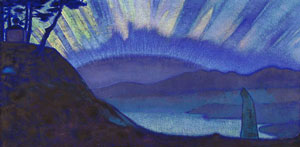
"Bridge of Glory" painting by Nicholas Roerich"
Read more...
BANNER OF PEACE
PAX
CULTURA
"Where there is Peace, there is Culture;
Where there is Culture, there is Peace."
- Nicholas Roerich
The
Banner of Peace is the official flag in use around the world by members of the
Planet Art Network and World Thirteen Moon Calendar Change Peace Movement. It
is displayed at all events, gatherings, and centers which promote natural time
and planetary peace."Where there is Peace, there is Culture;
Where there is Culture, there is Peace."
- Nicholas Roerich
The Roerich Pact and Banner of Peace was designed by Russian artist and humanitarian, Nicholas Roerich (1874 - 1947) as a response to the destruction of the first world war and the Russian Revolution.
It is an international treaty signed by India, the Baltic states, and 22 nations of the Americas including the United States. The Roerich Peace Pact established an international agreement allowing any nation to protect its cultural or artistic heritage with a symbolic banner, the Banner of Peace. Signed in 1935, this treaty is international law today.
Just as the Red Cross protects hospitals, the Banner of Peace was implemented to protect culture.
Written with the assistance of international experts and lawyers, the Banner of Peace was praised by many notable figures during its signing including Albert Einstein, George Bernard Shaw, and H.G. Wells. The Pact states, "educational, artistic, and scientific institutions... shall be protected and respected by the belligerents ... without any discrimination as to the state allegiance of any particular institution or mission... these missions may display a distinctive flag (the Banner of Peace).. which will entitle them to special protection and respect..." Thus any site of cultural activity around the world can fly the Banner of Peace to declare itself neutral, independent of combatant forces, and protected by international treaty.
Nicholas Roerich was an artist and travelled extensively through Russia, India, Tibet, and the United States. He hoped by using a symbol that represented all cultures no group would feel excluded from using it. The Banner would have not one but several meanings, as Nicholas Roerich himself wrote:
"Let us be united - you will ask in what way?
You will agree with me: in the easiest way,
to create a common and sincere language.
Perhaps in Beauty and in Knowledge."
The
distinctive Banner is three red circles surrounded by a larger red circle on
a white banner. The banner is a deep red or magenta color to symbolize the color
of our one blood, which is the same for all peoples. The top circle represents
spirituality and encompasses the truth of all religions, that we can all unite
regardless of our distinct beliefs. The two circles on the bottom represent
art and science. The circle that surrounds the three spheres represents culture,
the unity of art, science, and spirituality.
In
1993, Peace Pilgrims José
and Lloydine Argüelles
revived awareness of the Roerich Pact by using the Banner of Peace to represent
the aims of the World Thirteen Moon Calendar Change Peace Movement and the Planet
Art Network. With the strength of its historic and international validity, the
Planet Art Network has
reactivated this symbol, bringing its message of Peace to the Vatican, the United
Nations, as well as several world leaders, in efforts to promote global calendar
change. Argüelles
expanded Roerich's original motto to read "PAX CULTURA, PAX BIOSPHERICA",
adding an emphasis that we must protect the Biosphere, the Mother of all
Culture. "Peace through Culture. Peace with the Biosphere."
Read more...
"
"Where there is peace, there is culture
Where there is culture, there is peace."
(Nicholas Roerich, 1874-1947)
The Banner of Peace is a powerful universal symbol
which was adapted by the visionary artist Nicholas Roerich to serve as
an emblem for the desire of human culture to rise above war. This flag
has been flown globally, as a sign of peace and culture, since the
1930's.Where there is culture, there is peace."
(Nicholas Roerich, 1874-1947)
The Roerich Pact and Banner of Peace is an international treaty signed by India, the Baltic States, and 22 nations of the Americas including the United States. The Roerich Peace Pact established an international agreement allowing any nation to protect its cultural or artistic heritage with a symbolic banner, the Banner of Peace. Signed in 1935, this treaty is international law today.
Written with the assistance of international experts and lawyers, the Banner of Peace was praised by many notable figures during its signing including Albert Einstein, George Bernard Shaw, and H.G. Wells. The Pact states, “educational, artistic, and scientific institutions... shall be protected and respected by the belligerents... without any discrimination as to the state allegiance of any particular institution or mission... these missions may display a distinctive flag (the Banner of Peace)... which will entitle them to special protection and respect...” Thus any site of cultural activity around the world can fly the Banner of Peace to declare itself neutral, independent of combatant forces, and protected by international treaty.
The distinctive banner has three red circles surrounded by a larger red circle on a white banner. The banner is a deep red or magenta color to symbolize the color of our one blood, which is the same for all peoples. The top circle represents spirituality and encompasses the truth of all religions, that we can all unite regardless of our distinct beliefs. The two circles on the bottom represent art and science. The circle that surrounds the three spheres represents culture, the unity of art, science, and spirituality.
"Bridge of Glory" painting by Nicholas Roerich"
Read more...
Saturday, December 28, 2013
Socrates
Socrates, (born c. 470 bce, Athens [Greece]—died 399 bce, Athens), Greek philosopher whose way of life, character, and thought exerted a profound influence on ancient and modern philosophy.
Socrates was a widely recognized and controversial figure in his native Athens, so much so that he was frequently mocked in the plays of comic dramatists. (The Clouds of Aristophanes, produced in 423, is the best-known example.) Although Socrates himself wrote nothing, he is depicted in conversation in compositions by a small circle of his admirers—Plato and Xenophon first among them. He is portrayed in these works as a man of great insight, integrity, self-mastery, and argumentative skill. The impact of his life was all the greater because of the way in which it ended: at age 70, he was brought to trial on a charge of impiety and sentenced to death by poisoning (the poison probably being hemlock) by a jury of his fellow citizens. Plato’s Apology of Socrates purports to be the speech Socrates gave at his trial in response to the accusations made against him (Greek apologia means “defense”). Its powerful advocacy of the examined life and its condemnation of Athenian democracy have made it one of the central documents of Western thought and culture."
Read more...
More info...
Trial of Socrates
The Window Philosophers
Stanford Wiki of Philosophy
Socrates was a widely recognized and controversial figure in his native Athens, so much so that he was frequently mocked in the plays of comic dramatists. (The Clouds of Aristophanes, produced in 423, is the best-known example.) Although Socrates himself wrote nothing, he is depicted in conversation in compositions by a small circle of his admirers—Plato and Xenophon first among them. He is portrayed in these works as a man of great insight, integrity, self-mastery, and argumentative skill. The impact of his life was all the greater because of the way in which it ended: at age 70, he was brought to trial on a charge of impiety and sentenced to death by poisoning (the poison probably being hemlock) by a jury of his fellow citizens. Plato’s Apology of Socrates purports to be the speech Socrates gave at his trial in response to the accusations made against him (Greek apologia means “defense”). Its powerful advocacy of the examined life and its condemnation of Athenian democracy have made it one of the central documents of Western thought and culture."
Read more...
More info...
Trial of Socrates
The Window Philosophers
Stanford Wiki of Philosophy
Thursday, December 19, 2013

Subscribe to:
Posts (Atom)