"Raise your voice on social media and demand that Tyson Foods, the largest poultry producer, provide adequate bathroom breaks to workers. "
- Oxfarm America
Showing posts with label BigFood. Show all posts
Showing posts with label BigFood. Show all posts
Thursday, May 12, 2016
Lives on the line :High cost of chicken
"We eat a lot of it—89 pounds per person each year. Chicken is America’s most popular meat. From nuggets to sandwiches to wings, poultry is a $50-billion industry.
But how does all that chicken reach your plate? It’s not easy to turn a live bird into a bucket of buffalo wings. In fact, it takes a lot of work: hanging, cutting, trimming.
We’ll show you what the poultry industry doesn’t want you to see, and tell you exactly what you can do to help workers in their struggle."
Check out Lives on the line's official website
More Info..
But how does all that chicken reach your plate? It’s not easy to turn a live bird into a bucket of buffalo wings. In fact, it takes a lot of work: hanging, cutting, trimming.
We’ll show you what the poultry industry doesn’t want you to see, and tell you exactly what you can do to help workers in their struggle."
Check out Lives on the line's official website
More Info..
Poultry companies are denying their workers bathroom breaks. @ Oxfarm America
"Last fall, Oxfam released our report, Lives on the Line, and an immersive web site to share stories, photos and videos from US poultry workers—women and men who want you to understand what’s wrong with the industry and how you can help. We’ve been pressing hard since then: using our power as consumers to demand better working conditions from companies, encouraging federal agencies to expand their efforts, engaging with companies, filing shareholder resolutions—and more."
See more @ Oxfarm America
More Info...
See more @ Oxfarm America
More Info...
Friday, June 5, 2015
[Video] War on Health - Gary Null's documentary exposing the FDA
People aren't healthy because they don't eat healthy but sadly, eating healthy is illegal.
Monday, May 25, 2015
Sunday, April 19, 2015
Watch Food Inc. @ FilmsForAction
3 or companies control all the meat and almost all of the brand name foods we eat. But it's because we are fat that health problems occur, right?
"or most Americans, the ideal meal is fast, cheap, and tasty. Food, Inc. examines the costs of putting value and convenience over nutrition and environmental impact.
Director Robert Kenner explores the subject from all angles, talking to authors, advocates, farmers, and CEOs, like co-producer Eric Schlosser (Fast Food Nation), Michael Pollan (The Omnivore’s Dilemma), Gary Hirschberg (Stonyfield Farms), and Barbara Kowalcyk, who’s been lobbying for more rigorous standards since E. coli claimed the life of her two-year-old son.
The filmmaker takes his camera into slaughterhouses and factory farms where chickens grow too fast to walk properly, cows eat feed pumped with toxic chemicals, and illegal immigrants risk life and limb to bring these products to market at an affordable cost. If eco-docs tends to preach to the converted, Kenner presents his findings in such an engaging fashion that Food, Inc. may well reach the very viewers who could benefit from it the most: harried workers who don’t have the time or income to read every book and eat non-genetically modified produce every day.
Though he covers some of the same ground as Super Size Me and King Korn, Food Inc. presents a broader picture of the problem, and if Kenner takes an understandably tough stance on particular politicians and corporations, he’s just as quick to praise those who are trying to be responsible – even Wal-Mart, which now carries organic products. That development may have more to do with economics than empathy, but the consumer still benefits, and every little bit counts."
Watch FoodInc. @ FilmsForAction
"or most Americans, the ideal meal is fast, cheap, and tasty. Food, Inc. examines the costs of putting value and convenience over nutrition and environmental impact.
Director Robert Kenner explores the subject from all angles, talking to authors, advocates, farmers, and CEOs, like co-producer Eric Schlosser (Fast Food Nation), Michael Pollan (The Omnivore’s Dilemma), Gary Hirschberg (Stonyfield Farms), and Barbara Kowalcyk, who’s been lobbying for more rigorous standards since E. coli claimed the life of her two-year-old son.
The filmmaker takes his camera into slaughterhouses and factory farms where chickens grow too fast to walk properly, cows eat feed pumped with toxic chemicals, and illegal immigrants risk life and limb to bring these products to market at an affordable cost. If eco-docs tends to preach to the converted, Kenner presents his findings in such an engaging fashion that Food, Inc. may well reach the very viewers who could benefit from it the most: harried workers who don’t have the time or income to read every book and eat non-genetically modified produce every day.
Though he covers some of the same ground as Super Size Me and King Korn, Food Inc. presents a broader picture of the problem, and if Kenner takes an understandably tough stance on particular politicians and corporations, he’s just as quick to praise those who are trying to be responsible – even Wal-Mart, which now carries organic products. That development may have more to do with economics than empathy, but the consumer still benefits, and every little bit counts."
Watch FoodInc. @ FilmsForAction
Saturday, April 4, 2015
Everyone in California is thirsty, except Nestle (because they're guzzling up all the water) from NowThis
Everyone in California is thirsty, except Nestle (because they're guzzling up all the water)
Posted by NowThis on Thursday, April 2, 2015
Monsanto's Dirty Dozen: The company's Top 12 - most awful products created. from GMOFreeUSA
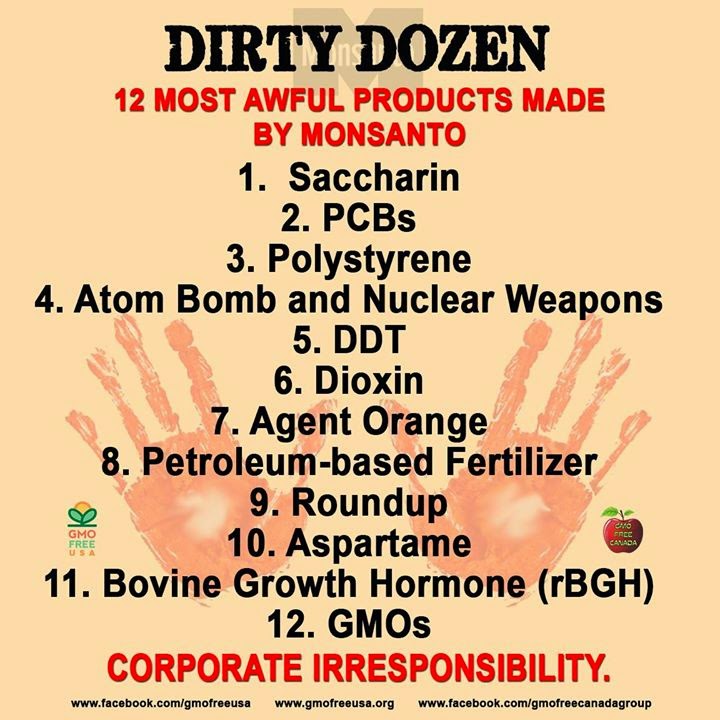
"Monsanto's Dirty Dozen: The company's Top 12 - most awful products created. In case you missed it, the World Health Organization declared Monsanto's flagship herbicide to be a probable human carcinogen based on their IARC review of published scientific studies which have found that it causes cancer in laboratory animals as well as establishing a link to Non-Hodgkins lymphoma. Monsanto sells over $5 billion worth of Roundup a year. More blood on their hands.
LINK to the IARC Report: http://www.gmofreeusa.org/wp-content/uploads/2015/03/2015_03_TheLancetOncology_CarcinogenicityOfTetrachlorvinphosParathionMalathionDiazinonGlyphosate.pdf"
Thursday, March 19, 2015
Monsanto Timeline Of Crime 1901-2014 @ Children of Vietnam Veterans Health Alliance
"1901: Monsanto was founded in St. Louis, Missouri by John Francis Queeny, a 30-year veteran of the pharmaceutical industry. Queeny funded the start-up with capital from Coca-Cola (saccharin). Founder John Francis Queeny named Monsanto Chemical Works after his wife, Olga Mendez Monsanto. Queeny’s father in law was Emmanuel Mendes de Monsanto, wealthy financier of a sugar company active in Vieques, Puerto Rico and based in St. Thomas in the Danish West Indies.
1902: Monsanto manufactures its first product, the artificial sweetener Saccharin, which Monsanto sold to the Coca-Cola Company. The U.S. government later files suit over the safety of Saccharin – but loses.

1926: Environmental policy was generally governed by local governments, Monsanto Chemical Company founded and incorporated the town of Monsanto, later renamed Sauget, Illinois, to provide a more business friendly environment for one of its chemical plants. For years, the Monsanto plant in Sauget was the nation’s largest producer of polychlorinated biphenyls (PCBs). And although polychlorinated biphenyls (PCBs) were banned in the 1970s, they remain in the water along Dead Creek in Sauget.
1902: Monsanto manufactures its first product, the artificial sweetener Saccharin, which Monsanto sold to the Coca-Cola Company. The U.S. government later files suit over the safety of Saccharin – but loses.
1926: Environmental policy was generally governed by local governments, Monsanto Chemical Company founded and incorporated the town of Monsanto, later renamed Sauget, Illinois, to provide a more business friendly environment for one of its chemical plants. For years, the Monsanto plant in Sauget was the nation’s largest producer of polychlorinated biphenyls (PCBs). And although polychlorinated biphenyls (PCBs) were banned in the 1970s, they remain in the water along Dead Creek in Sauget.
Tuesday, March 3, 2015
Avoiding GMOs means knowing what labels mean by StatesManJournal
"For instance, the word "natural" is used on a lot of food packaging, but it is really a marketing term and can mean whatever the company wants. A survey by the Consumer Reports National Research Center in 2014 found that nearly 60 percent of 1,000 people asked looked for the term "natural" when they shopped for food. About two-thirds believed it meant a processed food had no artificial ingredients or genetically modified organisms or pesticides; more than 80 percent believed that it should mean those things, according to the study.....
Natural: The Food and Drug Administration hasn't developed a formal definition for the term. The agency says that manufacturers can use natural if nothing artificial or synthetic has been added to the food, yet those ingredients are still found in many "natural" products.
Organic: Organic food is produced by farmers who emphasize the use of renewable resources and the conservation of soil and water to enhance environmental quality for future generations. Organic meat, poultry, eggs and dairy products come from animals that are given no antibiotics or growth hormones. Organic food is produced without using most conventional pesticides; fertilizers made with synthetic ingredients or sewage sludge; bioengineering; or ionizing radiation. Before a product can be labeled "organic," a government-approved certifier inspects the farm where the food is grown to make sure the farmer is following all the rules necessary to meet USDA organic standards. Companies that handle or process organic food before it gets to your supermarket or restaurant must be certified, too.
Non-GMO Project verified: Any product that carries the seal has gone through a verification process and follows best industry practices for avoiding GMO ingredients. And for high-risk products, every batch would be tested. The label does not necessarily mean that it is absolutely GMO free. The tolerance level is 0.9 percent, the same standard set by the European Union."
See entire article @ StatesManJournal
What they mean
Organic: Organic food is produced by farmers who emphasize the use of renewable resources and the conservation of soil and water to enhance environmental quality for future generations. Organic meat, poultry, eggs and dairy products come from animals that are given no antibiotics or growth hormones. Organic food is produced without using most conventional pesticides; fertilizers made with synthetic ingredients or sewage sludge; bioengineering; or ionizing radiation. Before a product can be labeled "organic," a government-approved certifier inspects the farm where the food is grown to make sure the farmer is following all the rules necessary to meet USDA organic standards. Companies that handle or process organic food before it gets to your supermarket or restaurant must be certified, too.
Non-GMO Project verified: Any product that carries the seal has gone through a verification process and follows best industry practices for avoiding GMO ingredients. And for high-risk products, every batch would be tested. The label does not necessarily mean that it is absolutely GMO free. The tolerance level is 0.9 percent, the same standard set by the European Union."
See entire article @ StatesManJournal
Thursday, February 12, 2015

Tuesday, February 3, 2015
What is the methamidophos (Monitor) pesticide?
"Methamidophos, trade name "Monitor," is an organophosphate insecticide.
Crops grown with the use of methamidophos include potatoes and some Latin American rice Many nations have used methamidophos on crops, including developed nations such as Spain, United States, Japan, and Australia. Due to its toxicity, the use of pesticides that contain methamidophos is currently being phased out in Brazil. In 2009, all uses in the United States were voluntarily canceled."
See more @ Wikipedia
More Info...
Crops grown with the use of methamidophos include potatoes and some Latin American rice Many nations have used methamidophos on crops, including developed nations such as Spain, United States, Japan, and Australia. Due to its toxicity, the use of pesticides that contain methamidophos is currently being phased out in Brazil. In 2009, all uses in the United States were voluntarily canceled."
See more @ Wikipedia
More Info...
Who is Michael Pollan?
*He reminds me of myself a bit because he's stated that eating healthy is the way to go towards a healthy lifestyle, not weight.
"Pollan's discussion of the industrial food chain is in large part a critique of modern agribusiness. According to the book, agribusiness has lost touch with the natural cycles of farming, wherein livestock and crops intertwine in mutually beneficial circles. Pollan's critique of modern agribusiness focuses on what he describes as the overuse of corn for purposes ranging from fattening cattle to massive production of corn oil, high-fructose corn syrup, and other corn derivatives.

He describes what he sees as the inefficiencies and other drawbacks of factory farming and gives his assessment of organic food production and what it's like to hunt and gather food. He blames those who set the rules (e.g., politicians in Washington, D.C., bureaucrats at the United States Department of Agriculture, Wall Street capitalists, and agricultural conglomerates like Archer Daniels Midland) of what he calls a destructive and precarious agricultural system that has wrought havoc upon the diet, nutrition, and well-being of Americans. Pollan finds hope in Joel Salatin's Polyface Farm in Virginia, which he sees as a model of sustainability in commercial farming. Pollan appears in the documentary film King Corn (2007)."
See more @ Wikipedia
More Info..
"Pollan's discussion of the industrial food chain is in large part a critique of modern agribusiness. According to the book, agribusiness has lost touch with the natural cycles of farming, wherein livestock and crops intertwine in mutually beneficial circles. Pollan's critique of modern agribusiness focuses on what he describes as the overuse of corn for purposes ranging from fattening cattle to massive production of corn oil, high-fructose corn syrup, and other corn derivatives.
He describes what he sees as the inefficiencies and other drawbacks of factory farming and gives his assessment of organic food production and what it's like to hunt and gather food. He blames those who set the rules (e.g., politicians in Washington, D.C., bureaucrats at the United States Department of Agriculture, Wall Street capitalists, and agricultural conglomerates like Archer Daniels Midland) of what he calls a destructive and precarious agricultural system that has wrought havoc upon the diet, nutrition, and well-being of Americans. Pollan finds hope in Joel Salatin's Polyface Farm in Virginia, which he sees as a model of sustainability in commercial farming. Pollan appears in the documentary film King Corn (2007)."
See more @ Wikipedia
More Info..
How Cooking Can Change Your Life - Michael Pollan
Not only is cooking and baking at home healthier, but it's fun, theraputic, emotional, very intimate, and it helps the community.
"Renowned activist and author Michael Pollan argues that cooking is one of the simplest and most important steps people can take to improve their family's health, build communities, fix our broken food system, and break our growing dependence on corporations. The event was chaired by Tim Lang, professor of Food Policy at City University London."
"Renowned activist and author Michael Pollan argues that cooking is one of the simplest and most important steps people can take to improve their family's health, build communities, fix our broken food system, and break our growing dependence on corporations. The event was chaired by Tim Lang, professor of Food Policy at City University London."
Thursday, January 15, 2015
Who Owns Organic? The Organic Corporate Brand List v1.4
"Ever wonder who owns organic brands you see on the shelves in the grocery store? Better still – which of all these new organic brands belongs to whom?
Well, it turns out you have come to the right place. This chart lays out the parent companies of each major organic label you are likely to see in the supermarket and what food stuffs they are selling. We have broken the chart into two distinct groups – agribusiness and independent labels (extended methodology is available below the chart). We hope this helps you determine the true owners of your food."
Saturday, January 10, 2015
Food - The Ultimate Secret Exposed
Yes, it is Alex Jones, but in this video, everything he says is true. Not sure if companies are poising us to take over the world, but they do love reaping the benefits of using cheaper additives even if it harms others.
Thursday, January 8, 2015
Michael Pollan's: "Don't Buy Any Food You've Ever Seen Advertised
This is not to Fat shame anyone or to tell people to lose weight... but to teach others how evil some companies and food really is.
Don't be afraid when people say "eat clean." So many amazing recipes and dishes come from veggies and grains.
Don't be afraid when people say "eat clean." So many amazing recipes and dishes come from veggies and grains.
Wednesday, December 24, 2014
Scientists need to rethink their beliefs about GMOs
"That said, compelling evidence was ignored in the opinion piece defending GMOs. First, potential human health risks associated with genetically engineered (GE) foods were never assessed. Government bureaucrats, under documented corporate pressures, simply ruled that crops modified by genetic engineering were "substantially equivalent" to crops selected through conventional plant breeding programs. This allowed GE food products to be classified "generally accepted as safe," which exempted GE foods from extensive tests to ensure that new foods are safe for consumption.
Independent testsraise major concerns
The genetic engineering process is not as precise as its defenders suggest. Genetic engineering differs from traditional plant breeding in many important ways. There are many unanswered questions regarding the effects of GE on the modified organism – as well as those who consume GE foods. The few truly independent tests conducted on GE foods have raised significant public health concerns that have never been adequately addressed...
Promoters of GMOs suggest that any potential risks associated with GMOs are outweighed by the benefits of GE crops to protect the environment and provide food for a growing global population. Corporations that promote GMOs are not nonprofit or philanthropic organizations; their legal responsibility is to serve investors and enhance short-term economic value of their investments. If we could be assured that the environment and the hungry were well cared for in the process, perhaps the motives wouldn't matter. But, that is not the case.
Independent testsraise major concerns
The genetic engineering process is not as precise as its defenders suggest. Genetic engineering differs from traditional plant breeding in many important ways. There are many unanswered questions regarding the effects of GE on the modified organism – as well as those who consume GE foods. The few truly independent tests conducted on GE foods have raised significant public health concerns that have never been adequately addressed...
Promoters of GMOs suggest that any potential risks associated with GMOs are outweighed by the benefits of GE crops to protect the environment and provide food for a growing global population. Corporations that promote GMOs are not nonprofit or philanthropic organizations; their legal responsibility is to serve investors and enhance short-term economic value of their investments. If we could be assured that the environment and the hungry were well cared for in the process, perhaps the motives wouldn't matter. But, that is not the case.
Subscribe to:
Posts (Atom)