Check out her channel
Showing posts with label Tech. Show all posts
Showing posts with label Tech. Show all posts
Monday, March 28, 2016
Check out Simone's Gietz's Youtube channel ("expert in shitty roborts")
"Maker/robotics enthusiast/non-engineer. Have become somewhat of an expert in shitty robots."
Check out her channel
Check out her channel
Thursday, June 4, 2015
Monday, December 29, 2014
Who was Al-Jazari?
"Badi'al-Zaman Abū al-'Izz ibn Ismā'īl ibn al-Razāz al-Jazarī (1136–1206) (Arabic: بديع الزمان أَبُو اَلْعِزِ بْنُ إسْماعِيلِ بْنُ الرِّزاز الجزري) was a Muslim polymath: a scholar, inventor, mechanical engineer, craftsman, artist, and mathematician from Jazirat ibn Umar (current Cizre, Turkey), who lived during the Islamic Golden Age (Middle Ages).

He is best known for writing the al-Jāmiʿ bain al-ʿilm wa al-ʿamal al-nāfiʿ fī ṣināʿat al-ḥiyal (The Book of Knowledge of Ingenious Mechanical Devices) in 1206, where he described 100 mechanical devices, some 80 of which are trick vessels of various kinds, along with instructions on how to construct them"
See more@ Wikipedia
More Info..
He is best known for writing the al-Jāmiʿ bain al-ʿilm wa al-ʿamal al-nāfiʿ fī ṣināʿat al-ḥiyal (The Book of Knowledge of Ingenious Mechanical Devices) in 1206, where he described 100 mechanical devices, some 80 of which are trick vessels of various kinds, along with instructions on how to construct them"
See more@ Wikipedia
More Info..
Saturday, November 22, 2014
Who is John Lilly (programmer)
"John Lilly (born 1971) is an American-born venture capitalist and currently serves on the board of directors of the Open Source Applications Foundation and Code for America. He earned a B.S. and M.S. in computer science from Stanford University and is the (co)-inventor on seven US patents.
Lilly was the Chief executive officer of the Mozilla Corporation from 2008–2010. The corporation, a subsidiary of the Mozilla Foundation, coordinates development of open source Mozilla Internet applications, including the Firefox web browser. Lilly, previously Mozilla's Chief operating officer, succeeded Mitchell Baker as CEO in January 2008.

In May 2010 Lilly announced he would step down as CEO. Lilly was succeeded by Gary Kovacs on November 8, 2010. Until March 2014 he was part of Mozilla board of directors"
See more about John Lilly @ Wikipedia
Lilly was the Chief executive officer of the Mozilla Corporation from 2008–2010. The corporation, a subsidiary of the Mozilla Foundation, coordinates development of open source Mozilla Internet applications, including the Firefox web browser. Lilly, previously Mozilla's Chief operating officer, succeeded Mitchell Baker as CEO in January 2008.
In May 2010 Lilly announced he would step down as CEO. Lilly was succeeded by Gary Kovacs on November 8, 2010. Until March 2014 he was part of Mozilla board of directors"
See more about John Lilly @ Wikipedia
Saturday, October 11, 2014
Thursday, October 9, 2014
Look Up by Gary Turk
It's okay to use electronics to make your life easier,but don't let it run your life.
Sunday, August 3, 2014
Tips, advice for being an assistant (tools for communication. time management)
I am a Executive assistant at Fancy Hands. I want to be the best I can be, so I am doing tons of research. Becoming an EA takes a lot of patience, practice and knowledge about communication, and using Excel. Posting the notes here because using these tips will help with communicating, listening, time management and becoming a better person. Using these tips can also help with manners, etc. Even if you are not interested in becoming a EA, or a PA take a look at these notes.
These are all "how-tos" Will be updated constantly.
Tips, advice for being an assistant
Fancy Hands
Word:
Grammar:
Spreadsheets
These are all "how-tos" Will be updated constantly.
Tips, advice for being an assistant
Fancy Hands
Word:
Grammar:
Spreadsheets
Monday, March 10, 2014
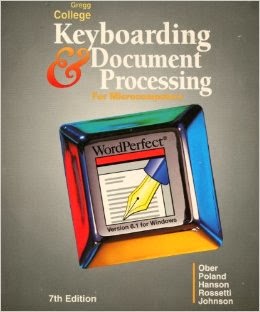
Keyboarding & Document Processing - Book
"Gregg College Keyboarding and Document Processing (GDP), 11e by Ober, Johnson, and Zimmerly: Your complete learning/teaching system. Your guide to success. GDP/11 is an integrated keyboarding system designed to process and score documents created in Microsoft Word. Together, the book and software systematically lead students through each lesson to provide an easy path to success. As a solid product for over 50 years, this version of the GDP software has grown into an online functionality. The same program is now web-based with seamless updates to provide greater accessibility for use at home, in class, and in labs - perfect for distance learning! Strong enhancements to the book while maintaining key elements including integrated language arts (starting at lesson 21) support the cohesive program's strong content. Skillbuilding is reinforced with MAP+ (Misstroke Analysis and Prescription). MAP+ is an individualized, diagnostic tool that is built into the software to help identify student's strengths and weaknesses while providing prescriptive drills to help them practice where they need it most. Also, MAP+ now has new, unlimited drill lines that begin at Lesson 1. Additionally, GDP/11 automatically scores for keyboarding errors and now formatting errors too! As a result, instructors will appreciate the customization of course management tools in GDP/11, including the new GPS (Grade Posting System) which allows complete flexibility in setting up grades. GDP/11 your complete learning/teaching system. Your guide to success."
More Info...
- Buy
- PDF:N/A

Tuesday, January 28, 2014
Speech Recognition Programs
According to the dictionary Speech Recognition is "the ability of a computer to identify and respond to the sounds produced in human speech."
You will have less wrist and finger pain, and more time. A blog post that may have taken you 10 minutes to type would have taken you 3 minutes to "talk." I highly recommend using voice/speech recognition software because it is worth it!
Dragon:

I have used it many times before but did not have time, or the need to train it to recognize my voice patterns. I now have a need and use for it and have started the trainning. If you have a speech impairment (which is easily fixable) it may take longer for the program to recognize what you are saying, but once it pick up on your speech pattern it will make less mistakes. If you choose to wait until a different time to train the program to recognize your voice there will be many mistakes when you try to use it to "type" a report, or essay. It will be frustrating and time consuming (so much that it would actually take less time to type the essay) but once you train the program, and learn how to use it, it is a big time saver. Speech recognition software h elps your hands rest for a while and you won't have to worry about the strain on your wrists and fingers.
Dragon comes in many different levels. From personal editions to business editions. From somewhat cheep, to very expensive. It all varies and depends on what you want and how much you can afford.
Knock- off Dragon programs
Of course, there are "knock-off" versions and generic versions of Dragon. If you feel you can not afford any of the Dragon programs avaibale these generic versions work just as well.
Windows 7 and higher built in program
And better yet, many computers come with a built in speech recognition program. I have Windows 7 so I can screen cap how to find it. Theres are two different ways you can find this program.
1.According to Windows' offical site one way you would find it is by following these steps:
- Open Speech Recognition by clicking the Start button
 , clicking All Programs, clicking Accessories, clicking Ease of Access, and then clicking Windows Speech Recognition.
 - Say "start listening" or click the Microphone button to start the listening mode.


2.Just type in "Windows Speech Recognition" in the "Search" box.

Thursday, January 9, 2014
Professional Records And Information Management
"Professional Records and Information Management 2e provides an overview of the field of records and information management. The text identifies the skills that are applicable to the management of records in all fields, including those in specialized areas - medical, legal, financial, and archived records management, as well as records center and depository management and records management consulting.

The text discusses employment and career opportunities as a records management professional and addresses legal and ethical issues in the records management field. The basics for both manual filing and electronic records management are addressed and reinforced through text and workbook practice set activities. The text includes a student CD-ROM containing Filing Rules Tutorial, a click-and-drag filing simulation, and templates for electronic activities in the textbook."
More info:
Buy
PDF:N?A
The text discusses employment and career opportunities as a records management professional and addresses legal and ethical issues in the records management field. The basics for both manual filing and electronic records management are addressed and reinforced through text and workbook practice set activities. The text includes a student CD-ROM containing Filing Rules Tutorial, a click-and-drag filing simulation, and templates for electronic activities in the textbook."
More info:
Buy
PDF:N?A
Sunday, December 15, 2013
Grace Hopper
"Grace Murray (Hopper) was born in New York City on 9 December 1906. She graduated from Vassar College in 1928 and received a PhD in Mathematics from Yale University in 1934. She was a member of the Vassar faculty from 1931 to 1943, when she joined the Naval Reserve. Commissioned a Lieutenant (Junior Grade) 1944, she was assigned to the Bureau of Ordnance and immediately became involved in the development of the then-embryonic electronic computer. Over more than four decades to follow, she was in the forefront of computer and programming language progress.
Leaving active duty after the war's end, Dr. Hopper was a member of the Harvard University faculty and, from 1949, was employed in private industry. She retained her Naval Reserve affiliation, attaining the rank of Commander before retiring at the end of 1966. In August 1967, Commander Hopper was recalled to active duty and assigned to the Chief of Naval Operations' staff as Director, Navy Programming Languages Group. She was promoted to Captain in 1973, Commodore in 1983 and Rear Admiral in 1985, a year before she retired from the Naval service. She remained active in industry and education until her death on 1 January 1992."
Read more...
Leaving active duty after the war's end, Dr. Hopper was a member of the Harvard University faculty and, from 1949, was employed in private industry. She retained her Naval Reserve affiliation, attaining the rank of Commander before retiring at the end of 1966. In August 1967, Commander Hopper was recalled to active duty and assigned to the Chief of Naval Operations' staff as Director, Navy Programming Languages Group. She was promoted to Captain in 1973, Commodore in 1983 and Rear Admiral in 1985, a year before she retired from the Naval service. She remained active in industry and education until her death on 1 January 1992."
Read more...
Saturday, November 9, 2013
Alan Turning
Alan Turing was born on 23 June, 1912, in London. His father was in the Indian Civil Service and Turing's parents lived in India until his father's retirement in 1926. Turing and his brother stayed with friends and relatives in England. Turing studied mathematics at Cambridge University, and subsequently taught there, working in the burgeoning world of quantum mechanics. It was at Cambridge that he developed the proof which states that automatic computation cannot solve all mathematical problems. This concept, also known as the Turing machine, is considered the basis for the modern theory of computation. In 1936, Turing went to Princeton University in America, returning to England in 1938. He began to work secretly part-time for the British cryptanalytic department, the Government Code and Cypher School. On the outbreak of war he took up full-time work at its headquarters, Bletchley Park. Here he played a vital role in deciphering the messages encrypted by the German Enigma machine, which provided vital intelligence for the Allies. He took the lead in a team that designed a machine known as a bombe that successfully decoded German messages. He became a well-known and rather eccentric figure at Bletchley. After the war, Turing turned his thoughts to the development of a machine that would logically process information. He worked first for the National Physical Laboratory (1945-1948). His plans were dismissed by his colleagues and the lab lost out on being the first to design a digital computer. It is thought that Turing's blueprint would have secured them the honour, as his machine was capable of computation speeds higher than the others. In 1949, he went to Manchester University where he directed the computing laboratory and developed a body of work that helped to form the basis for the field of artificial intelligence. In 1951 he was elected a fellow of the Royal Society..... He committed suicide on 7 June, 1954. more info..BBC More info....Stanford
Thursday, August 22, 2013
Subscribe to:
Posts (Atom)