See subatomic particles in action—with the naked eye.
Posted by NOVA on Wednesday, March 18, 2015
Showing posts with label Physics. Show all posts
Showing posts with label Physics. Show all posts
Sunday, May 24, 2015
See subatomic particles in action—with the naked eye. from NOVA
Friday, January 16, 2015
Check out Physics4Kids
"OKAY! Let's start here...
So you're asking, what is physics? Everything in the universe has an effect on every other thing. Physicists study those effects. Physics is a science that relates to all other sciences: Chemistry, Biology, Geology, Astronomy, Meteorology, Engineering, etc. If you can name it, chances are physics is involved.
Everything on Earth, everything in our solar system, everything in our galaxy, and everything in the Universe moves and interacts, and forces play a big part in that. Physics studies those forces and interactions. Let's get started and look inside the physics of motion called classical mechanics. Go take a look! "
Check out Physics4Kids
So you're asking, what is physics? Everything in the universe has an effect on every other thing. Physicists study those effects. Physics is a science that relates to all other sciences: Chemistry, Biology, Geology, Astronomy, Meteorology, Engineering, etc. If you can name it, chances are physics is involved.
Everything on Earth, everything in our solar system, everything in our galaxy, and everything in the Universe moves and interacts, and forces play a big part in that. Physics studies those forces and interactions. Let's get started and look inside the physics of motion called classical mechanics. Go take a look! "
Check out Physics4Kids
Tuesday, December 23, 2014
[Pic:] Weight, calories, fat scientifically defined
*Click pic to enlarge then if you still can't see it (not sure why it is still tiny and not full size) right click and push "open in new tab" and then click on the picture to "zoom in"

Tuesday, December 9, 2014
Who is Nigel Stanford and how does he perform cymatics?
"We’re constantly surrounded by a fabulously intricate invisible cacophony we register as sound. We hear it all, of course – at least, the tiny band our ears can register – but as a highly visual society, it’s rich to meditate on what we’d see, if only we could see all the interpenetrating pressure waves around us.
Think of crashing waves in every direction: fluid, turbulent, complex. This is the stuff of which we’re made, if we believe the physicists who claim a particle is just the node where waves collide and amplify each other. Then stack those nodes as notes into a symphony of flesh – and we are living music, not to put too fine a point on it....
See the entire article @ Channel 3 Globefish
More Info..
Think of crashing waves in every direction: fluid, turbulent, complex. This is the stuff of which we’re made, if we believe the physicists who claim a particle is just the node where waves collide and amplify each other. Then stack those nodes as notes into a symphony of flesh – and we are living music, not to put too fine a point on it....
See the entire article @ Channel 3 Globefish
More Info..
- Nigel's official site
- His videos on Vimeo
- His cymatics video:
CYMATICS: Science Vs. Music - Nigel Stanford from Nigel Stanford on Vimeo.
Sunday, August 24, 2014
What is entropy?
"Entropy, the measure of a system’s thermal energy per unit temperature that is unavailable for doing useful work. Because work is obtained from ordered molecular motion, the amount of entropy is also a measure of the molecular disorder, or randomness, of a system. The concept of entropy provides deep insight into the direction of spontaneous change for many everyday phenomena. Its introduction by the German physicist Rudolf Clausius in 1850 is a highlight of 19th-century physics.
The idea of entropy provides a mathematical way to encode the intuitive notion of which processes are impossible, even though they would not violate the fundamental law of conservation of energy. For example, a block of ice placed on a hot stove surely melts, while the stove grows cooler. Such a process is called irreversible because no slight change will cause the melted water to turn back into ice while the stove grows hotter. In contrast, a block of ice placed in an ice-water bath will either thaw a little more or freeze a little more, depending on whether a small amount of heat is added to or subtracted from the system. Such a process is reversible because only an infinitesimal amount of heat is needed to change its direction from progressive freezing to progressive thawing. Similarly, compressed gas confined in a cylinder could either expand freely into the atmosphere if a valve were opened (an irreversible process), or it could do useful work by pushing a moveable piston against the force needed to confine the gas. The latter process is reversible because only a slight increase in the restraining force could reverse the direction of the process from expansion to compression. For reversible processes the system is in equilibrium with its environment, while for irreversible processes it is not.
To provide a quantitative measure for the direction of spontaneous change, Clausius introduced the concept of entropy as a precise way of expressing the second law of thermodynamics. The Clausius form of the second law states that spontaneous change for an irreversible process in an isolated system (that is, one that does not exchange heat or work with its surroundings) always proceeds in the direction of increasing entropy. For example, the block of ice and the stove constitute two parts of an isolated system for which total entropy increases as the ice melts.
The idea of entropy provides a mathematical way to encode the intuitive notion of which processes are impossible, even though they would not violate the fundamental law of conservation of energy. For example, a block of ice placed on a hot stove surely melts, while the stove grows cooler. Such a process is called irreversible because no slight change will cause the melted water to turn back into ice while the stove grows hotter. In contrast, a block of ice placed in an ice-water bath will either thaw a little more or freeze a little more, depending on whether a small amount of heat is added to or subtracted from the system. Such a process is reversible because only an infinitesimal amount of heat is needed to change its direction from progressive freezing to progressive thawing. Similarly, compressed gas confined in a cylinder could either expand freely into the atmosphere if a valve were opened (an irreversible process), or it could do useful work by pushing a moveable piston against the force needed to confine the gas. The latter process is reversible because only a slight increase in the restraining force could reverse the direction of the process from expansion to compression. For reversible processes the system is in equilibrium with its environment, while for irreversible processes it is not.
To provide a quantitative measure for the direction of spontaneous change, Clausius introduced the concept of entropy as a precise way of expressing the second law of thermodynamics. The Clausius form of the second law states that spontaneous change for an irreversible process in an isolated system (that is, one that does not exchange heat or work with its surroundings) always proceeds in the direction of increasing entropy. For example, the block of ice and the stove constitute two parts of an isolated system for which total entropy increases as the ice melts.
Monday, February 10, 2014
Photodiodes
"This light detector is a current-to-voltage converter. The FET input op-amp prevents the loading of the photodiode and the voltage at the output is proportional to the current in the photodiode. So long as the photodiode response to the light is linear, the output voltage is proportional to the light falling on the photodiode.....
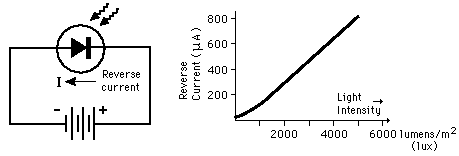
A photodiode consists of an active p-n junction which is operated in reverse bias. When light falls on the junction, a reverse current flows which is proportional to the illuminance. The linear response to light makes it an element in useful photodetectors for some applications. It is also used as the active element in light-activated switches."
See more
@Hyper Physics
A photodiode consists of an active p-n junction which is operated in reverse bias. When light falls on the junction, a reverse current flows which is proportional to the illuminance. The linear response to light makes it an element in useful photodetectors for some applications. It is also used as the active element in light-activated switches."
See more
@Hyper Physics
Tuesday, January 14, 2014
Equilibrium,
1.
a state of rest or balance due to the equal action of opposing forces.
2.
equal balance between any powers, influences, etc.; equality of effect.
3.
mental or emotional balance; equanimity: The pressures of the situation caused her to lose her equilibrium.
4.
Chemistry . the condition existing when a chemical reaction and its reverse reaction proceed at equal rates. "
Credit

"the condition of a system in which all competing influences are balanced, in a wide variety of contexts"
Credit
More info...
List of types of equilibrium
a state of rest or balance due to the equal action of opposing forces.
2.
equal balance between any powers, influences, etc.; equality of effect.
3.
mental or emotional balance; equanimity: The pressures of the situation caused her to lose her equilibrium.
4.
Chemistry . the condition existing when a chemical reaction and its reverse reaction proceed at equal rates. "
Credit


"the condition of a system in which all competing influences are balanced, in a wide variety of contexts"
Credit
More info...
List of types of equilibrium
Friday, January 3, 2014
Tachyon
"Tachyons are a putative class of particles which able to travel faster than the speed of light. Tachyons were
first proposed by physicist Arnold Sommerfeld, and named by Gerald Feinberg. The word tachyon derives from the Greek
 (tachus), meaning "speedy." Tachyons have the strange properties that,
when they lose energy, they gain speed. Consequently, when tachyons gain energy, they slow down. The slowest
speed possible for tachyons is the speed of light.
(tachus), meaning "speedy." Tachyons have the strange properties that,
when they lose energy, they gain speed. Consequently, when tachyons gain energy, they slow down. The slowest
speed possible for tachyons is the speed of light.
Tachyons appear to violate causality (the so-called causality problem), since they could be sent to the past under the assumption that the principle of special relativity is a true law of nature, thus generating a real unavoidable time paradox (Maiorino and Rodrigues 1999). Therefore, it seems unavoidable that if tachyons exist, the principle of special relativity must be false, and there exists a unique time order for all observers in the universe independent of their state of motion.
Tachyons can be assigned properties of normal matter such as spin, as well as an antiparticle (the antitachyon). And amazingly, modern presentations of tachyon theory actually allow tachyons to actually have real mass (Recami 1996).
It has been proposed that tachyons could be produced from high-energy particle collisions, and tachyon searches have been undertaken in cosmic rays. Cosmic rays hit the Earth's atmosphere with high energy (some of them with speed almost 99.99% of the speed of light) making several collisions with the molecules in the atmosphere. The particles made by this collision interact with the air, creating even more particles in a phenomenon known as a cosmic ray shower. In 1973, using a large collection of particle detectors, Philip Crough and Roger Clay identified a putative superluminal particle in an air shower, although this result has never been reproduced."
Read more...
A tachyon /ˈtæki.ɒn/ or tachyonic particle is a hypothetical particle that always moves faster than light. The word comes from the Greek: ταχύς or tachys, meaning "swift, quick, fast, rapid", and was coined by Gerald Feinberg. Most physicists think that faster-than-light particles cannot exist because they are not consistent with the known laws of physics.if such particles did exist, they could be used to build a tachyonic antitelephone and send signals faster than light, which (according to special relativity) would lead to violations of causality.[3] Potentially consistent theories that allow faster-than-light particles include those that break Lorentz invariance, the symmetry underlying special relativity, so that the speed of light is not a barrier.
In the 1967 paper that coined the term,Feinberg proposed that tachyonic particles could be quanta of a quantum field with negative squared mass. However, it was soon realized that excitations of such imaginary mass fields do not in fact propagate faster than light, and instead represent an instability known as tachyon condensation. Nevertheless, negative squared mass fields are commonly referred to as "tachyons", and in fact have come to play an important role in modern physics.
Despite theoretical arguments against the existence of faster-than-light particles, experiments have been conducted to search for them. No compelling evidence for their existence has been found." (Wikipedia)
(tachus), meaning "speedy." Tachyons have the strange properties that,
when they lose energy, they gain speed. Consequently, when tachyons gain energy, they slow down. The slowest
speed possible for tachyons is the speed of light.
Tachyons appear to violate causality (the so-called causality problem), since they could be sent to the past under the assumption that the principle of special relativity is a true law of nature, thus generating a real unavoidable time paradox (Maiorino and Rodrigues 1999). Therefore, it seems unavoidable that if tachyons exist, the principle of special relativity must be false, and there exists a unique time order for all observers in the universe
independent of their state of motion.
Tachyons can be assigned properties of normal matter such as spin, as well as an antiparticle (the antitachyon). And amazingly, modern presentations of tachyon theory actually allow tachyons to actually have real mass (Recami 1996).
It has been proposed that tachyons could be produced from high-energy particle collisions, and tachyon searches have been undertaken in cosmic rays. Cosmic rays hit the Earth's atmosphere with high energy (some of them with speed almost 99.99% of the speed of light) making several collisions with the molecules in the atmosphere. The particles made by this collision interact with the air, creating even more particles in a phenomenon known as a cosmic ray shower. In 1973, using a large collection of particle detectors, Philip Crough and Roger Clay identified a putative superluminal particle in an air shower, although this result has never been reproduced."
Read more...
A tachyon /ˈtæki.ɒn/ or tachyonic particle is a hypothetical particle that always moves faster than light. The word comes from the Greek: ταχύς or tachys, meaning "swift, quick, fast, rapid", and was coined by Gerald Feinberg. Most physicists think that faster-than-light particles cannot exist because they are not consistent with the known laws of physics.if such particles did exist, they could be used to build a tachyonic antitelephone and send signals faster than light, which (according to special relativity) would lead to violations of causality.[3] Potentially consistent theories that allow faster-than-light particles include those that break Lorentz invariance, the symmetry underlying special relativity, so that the speed of light is not a barrier.
In the 1967 paper that coined the term,Feinberg proposed that tachyonic particles could be quanta of a quantum field with negative squared mass. However, it was soon realized that excitations of such imaginary mass fields do not in fact propagate faster than light, and instead represent an instability known as tachyon condensation. Nevertheless, negative squared mass fields are commonly referred to as "tachyons", and in fact have come to play an important role in modern physics.
Despite theoretical arguments against the existence of faster-than-light particles, experiments have been conducted to search for them. No compelling evidence for their existence has been found." (Wikipedia)
Hadrons, Baryons, and Mesons
"The Large Hadron Collider is a wonderful and exciting machine. But first things first — what’s a hadron??!!
A hadron is any particle that is made from quarks, anti-quarks and gluons. (If you want to learn more about quarks and gluons, start here.) The most famous example of a hadron is a proton, which I have described in detail here, and I would suggest you read this first if you are interested in hadrons. Because once you understand the proton, then you understand almost everything there is to know about a hadron…
In particular, you will understand that a proton is made of two up quarks, a down quark, and a large number of gluons and of quark-antiquark pairs.
A neutron is basically the same as a proton except that it has one up quark and two down quarks in addition to its large number of gluons and of quark-antiquark pairs. Unlike a proton, which has charge +1 (in fact it defines what it means to have charge +1), the neutron is electrically neutral — has charge 0 — hence its name
A pion-plus, of charge +1, differs from a proton in that it has an up quark and a down anti-quark in addition to its large number of gluons and of quark-antiquark pairs.
A Kaon-plus is like a pion-plus except that it has an up quark and a strange anti-quark (in addition to its… ok, ok.)
Get the point? Each hadron has large number of gluons and of quark-antiquark pairs, plus something else. The something else may include
Atomic nuclei are made from protons and neutrons, so they too are made from quarks, anti-quarks and gluons. And they also are often called hadrons. One month a year, the Large Hadron Collider, which mostly hosts collisions of protons, is used to create collisions of atomic nuclei (in particular, nuclei of lead.) So that’s why it isn’t called the Large Proton Collider!"
Read more ...

"Like social elephants, quarks only exist in groups with other quarks and are never found alone. Composite particles made of quarks are called Hadrons.
Although individual quarks have fractional electrical charges, they combine such that
hadrons have a net integer electric charge. Another property of hadrons is that
they have no net color charge even though the quarks themselves carry color charge (we will talk more
about this later).
There are two classes of hadrons (try putting your mouse on the elephants):
A weird thing about hadrons is that only a very very very
small part of the mass of a hadron is
due to the quarks in it."
Read more...
More info...
About (dot) com
A hadron is any particle that is made from quarks, anti-quarks and gluons. (If you want to learn more about quarks and gluons, start here.) The most famous example of a hadron is a proton, which I have described in detail here, and I would suggest you read this first if you are interested in hadrons. Because once you understand the proton, then you understand almost everything there is to know about a hadron…
In particular, you will understand that a proton is made of two up quarks, a down quark, and a large number of gluons and of quark-antiquark pairs.
A neutron is basically the same as a proton except that it has one up quark and two down quarks in addition to its large number of gluons and of quark-antiquark pairs. Unlike a proton, which has charge +1 (in fact it defines what it means to have charge +1), the neutron is electrically neutral — has charge 0 — hence its name
A pion-plus, of charge +1, differs from a proton in that it has an up quark and a down anti-quark in addition to its large number of gluons and of quark-antiquark pairs.
A Kaon-plus is like a pion-plus except that it has an up quark and a strange anti-quark (in addition to its… ok, ok.)
Get the point? Each hadron has large number of gluons and of quark-antiquark pairs, plus something else. The something else may include
- Three quarks of various types
- Three anti-quarks of various types
- A quark and an anti-quark, possibly of different types
- Extra energy, distributed among the many quarks, anti-quarks and gluons.
Atomic nuclei are made from protons and neutrons, so they too are made from quarks, anti-quarks and gluons. And they also are often called hadrons. One month a year, the Large Hadron Collider, which mostly hosts collisions of protons, is used to create collisions of atomic nuclei (in particular, nuclei of lead.) So that’s why it isn’t called the Large Proton Collider!"
Read more ...
"Like social elephants, quarks only exist in groups with other quarks and are never found alone. Composite particles made of quarks are called Hadrons.
There are two classes of hadrons (try putting your mouse on the elephants):
  |
  ). ).
  +),
which is made of an up quark and
a down anitiquark. The antiparticle of a meson just has its quark and antiquark switched, so an antipion (-)
is made of a down quark and an up antiquark. +),
which is made of an up quark and
a down anitiquark. The antiparticle of a meson just has its quark and antiquark switched, so an antipion (-)
is made of a down quark and an up antiquark.
Because a meson consists of a particle and an antiparticle, it is very unstable. The kaon (K-) meson lives much longer than most mesons, which is why it was called "strange" and gave this name to the strange quark, one of its components. |
Read more...
More info...
About (dot) com
Tuesday, December 31, 2013
Sonoluminescence
Sonoluminescence is the emission of short bursts of light from imploding bubbles in a liquid when excited by sound. (Wikipedia)

More info...
Scientific American

More info...
Scientific American
Tuesday, December 17, 2013
Werner Heisenberg
"... best known as a founder of quantum mechanics, the new physics of the atomic world, and especially for the uncertainty principle in quantum theory. He is also known for his controversial role as a leader of Germany's nuclear fission research during World War II. After the war he was active in elementary particle physics and West German science policy.
Read more
More info...
PBS
Read more
More info...
PBS
Subscribe to:
Posts (Atom)