
Showing posts with label Logic. Show all posts
Showing posts with label Logic. Show all posts
Thursday, January 14, 2016
Tuesday, March 18, 2014
Epicureanism
"Epicureanism is a system of philosophy based upon the teachings of Epicurus, founded around 307 BC. Epicurus was an atomic materialist, following in the steps of Democritus. His materialism led him to a general attack on superstition and divine intervention. Following Aristippus—about whom very little is known—Epicurus believed that what he called "pleasure" is the greatest good, but the way to attain such pleasure is to live modestly and to gain knowledge of the workings of the world and the limits of one's desires. This led one to attain a state of tranquility (ataraxia) and freedom from fear, as well as absence of bodily pain (aponia). The combination of these two states is supposed to constitute happiness in its highest form. Although Epicureanism is a form of hedonism, insofar as it declares pleasure to be the sole intrinsic good, its conception of absence of pain as the greatest pleasure and its advocacy of a simple life make it different from "hedonism" as it is commonly understood.

Epicureanism was originally a challenge to Platonism, though later it became the main opponent of Stoicism. Epicurus and his followers shunned politics. After the death of Epicurus, his school was headed by Hermarchus; later many Epicurean societies flourished in the Late Hellenistic era and during the Roman era (such as those in Antiochia, Alexandria, Rhodes, and Ercolano). Its best-known Roman proponent was the poet Lucretius. By the end of the Roman Empire, being opposed by philosophies (mainly Neo-Platonism) that were now in the ascendance, Epicureanism had all but died out, and would be resurrected in the 17th century by the atomist Pierre Gassendi, who adapted it to the Christian doctrine.
Some writings by Epicurus have survived. Some scholars consider the epic poem On the Nature of Things by Lucretius to present in one unified work the core arguments and theories of Epicureanism. Many of the papyrus scrolls unearthed at the Villa of the Papyri at Herculaneum are Epicurean texts. At least some are thought to have belonged to the Epicurean Philodemus."
See more..
@Wikipedia
More Info...
Epicureanism was originally a challenge to Platonism, though later it became the main opponent of Stoicism. Epicurus and his followers shunned politics. After the death of Epicurus, his school was headed by Hermarchus; later many Epicurean societies flourished in the Late Hellenistic era and during the Roman era (such as those in Antiochia, Alexandria, Rhodes, and Ercolano). Its best-known Roman proponent was the poet Lucretius. By the end of the Roman Empire, being opposed by philosophies (mainly Neo-Platonism) that were now in the ascendance, Epicureanism had all but died out, and would be resurrected in the 17th century by the atomist Pierre Gassendi, who adapted it to the Christian doctrine.
Some writings by Epicurus have survived. Some scholars consider the epic poem On the Nature of Things by Lucretius to present in one unified work the core arguments and theories of Epicureanism. Many of the papyrus scrolls unearthed at the Villa of the Papyri at Herculaneum are Epicurean texts. At least some are thought to have belonged to the Epicurean Philodemus."
See more..
@Wikipedia
More Info...
Platonism
"Platonism (with a capital "P") is the philosophy of Plato or the name of other philosophical systems considered closely derived from it. With a lower case "p", "platonism" refers to the philosophy that affirms the existence of abstract objects, which are asserted to "exist" in a "third realm distinct both from the sensible external world and from the internal world of consciousness, and is the opposite of nominalism (with a lower case "n"). Lower case "platonists" need not accept any of the doctrines of Plato.
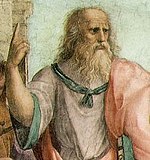
In a narrower sense the term might indicate the doctrine of Platonic realism. The central concept of Platonism is the distinction between the reality that is perceptible, but not intelligible, and that which is intelligible, but imperceptible; to this distinction the Theory of Forms is essential. The forms are typically described in dialogues such as the Phaedo, Symposium and Republic as transcendent, perfect archetypes, of which objects in the everyday world are imperfect copies. In the Republic the highest form is identified as the Form of the Good, the source of all other forms, which could be known by reason. In the Sophist, a later work, the forms being, sameness and difference are listed among the primordial "Great Kinds". In the 3rd century BC, Arcesilaus adopted skepticism, which became a central tenet of the school until 90 BC when Antiochus added Stoic elements, rejected skepticism, and began a period known as Middle Platonism. In the 3rd century AD, Plotinus added mystical elements, establishing Neoplatonism, in which the summit of existence was the One or the Good, the source of all things; in virtue and meditation the soul had the power to elevate itself to attain union with the One. Platonism had a profound effect on Western thought, and many Platonic notions were adopted by the Christian church which understood Platonic forms as God's thoughts, whilst Neoplatonism became a major influence on Christian mysticism, in the West through St Augustine, Doctor of the Catholic Church whose Christian writings were heavily influenced by Plotinus' Enneads, and in turn were foundations for the whole of Western Christian thought."
See more..
@Wikipedia
More Info...
In a narrower sense the term might indicate the doctrine of Platonic realism. The central concept of Platonism is the distinction between the reality that is perceptible, but not intelligible, and that which is intelligible, but imperceptible; to this distinction the Theory of Forms is essential. The forms are typically described in dialogues such as the Phaedo, Symposium and Republic as transcendent, perfect archetypes, of which objects in the everyday world are imperfect copies. In the Republic the highest form is identified as the Form of the Good, the source of all other forms, which could be known by reason. In the Sophist, a later work, the forms being, sameness and difference are listed among the primordial "Great Kinds". In the 3rd century BC, Arcesilaus adopted skepticism, which became a central tenet of the school until 90 BC when Antiochus added Stoic elements, rejected skepticism, and began a period known as Middle Platonism. In the 3rd century AD, Plotinus added mystical elements, establishing Neoplatonism, in which the summit of existence was the One or the Good, the source of all things; in virtue and meditation the soul had the power to elevate itself to attain union with the One. Platonism had a profound effect on Western thought, and many Platonic notions were adopted by the Christian church which understood Platonic forms as God's thoughts, whilst Neoplatonism became a major influence on Christian mysticism, in the West through St Augustine, Doctor of the Catholic Church whose Christian writings were heavily influenced by Plotinus' Enneads, and in turn were foundations for the whole of Western Christian thought."
See more..
@Wikipedia
More Info...
Monday, December 16, 2013
Ad Hominem
"You attacked your opponent's character or personal traits in an attempt to undermine their argument.
Ad hominem attacks can take the form of overtly attacking somebody, or more subtly casting doubt on their character or personal attributes as a way to discredit their argument. The result of an ad hom attack can be to undermine someone's case without actually having to engage with it.
Example: After Sally presents an eloquent and compelling case for a more equitable taxation system, Sam asks the audience whether we should believe anything from a woman who isn't married, was once arrested, and smells a bit weird."
Read more...
More info...
The Nizkor Project
Fallacy Files
Philosophy (dot) lander (dot) edu
Ad hominem attacks can take the form of overtly attacking somebody, or more subtly casting doubt on their character or personal attributes as a way to discredit their argument. The result of an ad hom attack can be to undermine someone's case without actually having to engage with it.
Example: After Sally presents an eloquent and compelling case for a more equitable taxation system, Sam asks the audience whether we should believe anything from a woman who isn't married, was once arrested, and smells a bit weird."
Read more...
More info...
The Nizkor Project
Fallacy Files
Philosophy (dot) lander (dot) edu
Saturday, December 14, 2013
The 12 cognitive biases that prevent you from being rational
"The human brain is capable of 1016 processes per second, which makes it far more powerful than any computer currently in existence. But that doesn't mean our brains don't have major limitations. The lowly calculator can do math thousands of times better than we can, and our memories are often less than useless — plus, we're subject to cognitive biases, those annoying glitches in our thinking that cause us to make questionable decisions and reach erroneous conclusions. Here are a dozen of the most common and pernicious cognitive biases that you need to know about....."
Confirmation Bias
Ingroup Bias
Gambler's Fallacy
Post-Purchase Rationalization
Neglecting Probability
Observational Selection Bias
Status-Quo Bias
Negativity Bias
Bandwagon Effect
Projection Bias
The Current Moment Bias
Anchoring Effect"
Read more....
Confirmation Bias
Ingroup Bias
Gambler's Fallacy
Post-Purchase Rationalization
Neglecting Probability
Observational Selection Bias
Status-Quo Bias
Negativity Bias
Bandwagon Effect
Projection Bias
The Current Moment Bias
Anchoring Effect"
Read more....
Subscribe to:
Posts (Atom)