Showing posts with label Buddhism. Show all posts
Showing posts with label Buddhism. Show all posts
Monday, September 21, 2015
Sunday, May 3, 2015

Saturday, March 28, 2015
What is this imperative Right Speech? From What Buddha said (dot) net
"The Characterization of Noble Speech:
Eliminating any false speech any Noble Friend dwells avoiding all lies,
a truth-speaker, one to be relied on, trustworthy, loyal, not a deceiver
of the world. Abstaining from malicious speech, he does not tell them there,
what he has heard about those here, or repeat here, what he heard there,
harming those there. Thus is he a reconciling diplomat stilling all quarrels.

The Noble Friend is rejoicing in peace, loving it, delighting in it, one who
defends peace. Abandoning all harsh and aggressive speech he refrains
from it. He speaks whatever is blameless and pleasing to the ear, agreeable,
touching the heart, elegant, gratifying and appealing to the many.
Discarding idle and empty chatter, he speaks at the right time & only about
what is correct, advantageous & to the point, of Dhamma and self-control.
He is a speaker, whose words are to be treasured and remembered, timely,
reasoned, well-defined, well-formulated, beneficial and leading to the goal...
This is Right and Noble Speech!"
See full explanation & all of the Right Speech practices @ What Buddha Said
Eliminating any false speech any Noble Friend dwells avoiding all lies,
a truth-speaker, one to be relied on, trustworthy, loyal, not a deceiver
of the world. Abstaining from malicious speech, he does not tell them there,
what he has heard about those here, or repeat here, what he heard there,
harming those there. Thus is he a reconciling diplomat stilling all quarrels.
The Noble Friend is rejoicing in peace, loving it, delighting in it, one who
defends peace. Abandoning all harsh and aggressive speech he refrains
from it. He speaks whatever is blameless and pleasing to the ear, agreeable,
touching the heart, elegant, gratifying and appealing to the many.
Discarding idle and empty chatter, he speaks at the right time & only about
what is correct, advantageous & to the point, of Dhamma and self-control.
He is a speaker, whose words are to be treasured and remembered, timely,
reasoned, well-defined, well-formulated, beneficial and leading to the goal...
This is Right and Noble Speech!"
See full explanation & all of the Right Speech practices @ What Buddha Said

Saturday, March 7, 2015

Brahma-vihara: The Four Divine States or Four Immeasurables by Barbara O'Brien @ About (dot) com
"The Buddha taught his monks to arouse four states of mind, called the "Brahma-vihara" or "four divine states of dwelling." These four states are sometimes called the "Four Immeasurables" or the "Four Perfect Virtues."
The four states are metta (loving kindness), karuna (compassion), mudita (sympathetic joy or empathy) and upekkha (equanimity), and in many Buddhist traditions these four states are cultivated through meditation. These four states also inter-relate and support each other.
It's important to understand that these mental states are not emotions. Nor is it possible to simply make up your mind you are going to be loving, compassionate, empathetic and balanced from now on. Truly dwelling in these four states requires changing how you experience and perceive yourself and others. Loosening the bonds of self-reference and ego is especially important.
The four states are metta (loving kindness), karuna (compassion), mudita (sympathetic joy or empathy) and upekkha (equanimity), and in many Buddhist traditions these four states are cultivated through meditation. These four states also inter-relate and support each other.
It's important to understand that these mental states are not emotions. Nor is it possible to simply make up your mind you are going to be loving, compassionate, empathetic and balanced from now on. Truly dwelling in these four states requires changing how you experience and perceive yourself and others. Loosening the bonds of self-reference and ego is especially important.
- Metta, Loving Kindness
- Karuna, Compassion
- Mudita, Sympathetic Joy
- Upekkha, Equanimity
Wednesday, February 25, 2015
Check out Kundalini2014's channel
Tons of videos to help you awaken your Kundalini energy
Description form Youtube:
"This channel is dedicated to teachings of the Kundalini."
Check out Kundalini2014's channel
Description form Youtube:
"This channel is dedicated to teachings of the Kundalini."
Check out Kundalini2014's channel
Friday, December 19, 2014
Ram Das/ Love Serve Remember Foundation/ podcasts, videos about love
"Ram Dass first went to India in 1967. He was still Dr. Richard Alpert, a prominent Harvard psychologist and psychedelic pioneer with Dr. Timothy Leary. He continued his psychedelic research until that fateful Eastern trip in 1967, when he traveled to India. In India, he met his guru, Neem Karoli Baba, affectionately known as Maharajji, who gave Ram Dass his name, which means “servant of God.” Everything changed then – his intense dharmic life started, and he became a pivotal influence on a culture that has reverberated with the words “Be Here Now” ever since. Ram Dass’ spirit has been a guiding light for three generations, carrying along millions on the journey, helping to free them from their bonds as he works through his own.
Since 1968, Ram Dass has pursued a panoramic array of spiritual methods and practices from potent ancient wisdom traditions, including bhakti or devotional yoga focused on the Hindu deity Hanuman; Buddhist meditation in the Theravadin, Mahayana Tibetan and Zen Buddhist schools, and Sufi and Jewish mystical studies. Perhaps most significantly, his practice of karma yoga or spiritual service has opened up millions of other souls to their deep, yet individuated spiritual practice and path. Ram Dass continues to uphold the boddhisatva ideal for others through his compassionate sharing of true knowledge and vision. His unique skill in getting people to cut through and feel divine love without dogma is still a positive influence on many people from all over the planet."
See his entire biography @ official site

""The Love Serve Remember Foundation is dedicated to preserving and continuing the teachings of Neem Karoli Baba and Ram Dass. The foundation facilitates the continuation of these teachings through Web casts, Private Heart 2 Hearts with Ram Dass, online courses and e-books, Words of Wisdom, a vast Media Library, and a Social Network all available on RamDass.org. In addition the Love Serve Remember Foundation sponsors retreats led by Ram Dass and featuring other esteemed spiritual teachers on Maui."
More Info...
Since 1968, Ram Dass has pursued a panoramic array of spiritual methods and practices from potent ancient wisdom traditions, including bhakti or devotional yoga focused on the Hindu deity Hanuman; Buddhist meditation in the Theravadin, Mahayana Tibetan and Zen Buddhist schools, and Sufi and Jewish mystical studies. Perhaps most significantly, his practice of karma yoga or spiritual service has opened up millions of other souls to their deep, yet individuated spiritual practice and path. Ram Dass continues to uphold the boddhisatva ideal for others through his compassionate sharing of true knowledge and vision. His unique skill in getting people to cut through and feel divine love without dogma is still a positive influence on many people from all over the planet."
See his entire biography @ official site
""The Love Serve Remember Foundation is dedicated to preserving and continuing the teachings of Neem Karoli Baba and Ram Dass. The foundation facilitates the continuation of these teachings through Web casts, Private Heart 2 Hearts with Ram Dass, online courses and e-books, Words of Wisdom, a vast Media Library, and a Social Network all available on RamDass.org. In addition the Love Serve Remember Foundation sponsors retreats led by Ram Dass and featuring other esteemed spiritual teachers on Maui."
More Info...
Tuesday, December 2, 2014
Saturday, November 22, 2014
Shakyumuni Buddha and the 10 states of consciousness
"The Buddhist teaching of the nine consciousnesses offers the basis for a comprehensive understanding of who we are, our true identity. It also helps explain how Buddhism sees the eternal continuity of our lives over cycles of birth and death. This perspective on the human being is the fruit of thousands of years of intense introspective investigation into the nature of consciousness. Historically, it is grounded in efforts to experience and explain the essence of Shakyamuni's enlightenment beneath the bodhi tree some 2,500 years ago.
The nine consciousnesses can be thought of as different layers of consciousness which are constantly operating together to create our lives. The Sanskrit word vijnāna, which is translated as consciousness, includes a wide range of activities, including sensation, cognition and conscious thought. The first five of these consciousnesses are the familiar senses of sight, hearing, smell, taste and touch. The sixth consciousness is the function that integrates and processes the various sensory data to form an overall picture or thought, identifying what it is that our five senses are communicating to us. It is primarily with these six functions of life that we perform our daily activities.
Below this level of consciousness is the seventh consciousness. Unlike those layers of consciousness that are directed toward the outer world, the seventh consciousness is directed toward our inner life and is largely independent of sensory input. The seventh consciousness is the basis for our sense of individual identity; attachment to a self distinct to and separate from others has its basis in this consciousness, as does our sense of right and wrong.
Below the seventh consciousness, Buddhism elucidates a deeper layer, the eighth or ālaya consciousness, also known as the never-perishing or storehouse consciousness. It is here that the energy of our karma resides. Whereas the first seven consciousnesses disappear on death, the eighth consciousness persists through the cycles of active life and the latency of death. It can be thought of as the life-flow that supports the activities of the other consciousnesses. The experiences described by those who have undergone clinical death and been revived could be said to be occurrences at the borderline of the seventh and eighth consciousnesses.
An understanding of these levels of consciousness and the interaction between them can offer valuable insights into the nature of life and the self, as well as pointing to the resolution of the fundamental problems that humanity confronts.
According to Buddhist teachings, there are specific deep-seated delusions in the seventh consciousness regarding the nature of self. These delusions arise from the relationship between the seventh and eighth levels of consciousness and manifest as fundamental egotism.
Buddhist teachings describe the seventh layer as emerging from the eighth consciousness: it is always focused on the eighth consciousness of the individual, which it perceives as something fixed, unique and isolated from other things. In reality, the eighth consciousness is in a state of continual flux. At this level our lives constantly interact, exerting a profound influence on each other. The perception of a fixed and isolated self that the seventh consciousness generates is thus false.
The seventh consciousness is also the seat of the fear of death. Being unable to perceive the true nature of the eighth consciousness as an enduring flow of life energy, it imagines that upon death, the eighth consciousness will become permanently extinct. Fear of death thus has roots in the deep layers of the subconscious.
The delusion that the eighth consciousness is one's true self is also termed fundamental ignorance, a turning away from the interconnectedness of all being. It is this sense of one's self as separate and isolated from others that gives rise to discrimination, to destructive arrogance and unbridled acquisitiveness. Humanity's ravaging of the natural environment is another obvious result."
See more @ SGI
More Info..
The nine consciousnesses can be thought of as different layers of consciousness which are constantly operating together to create our lives. The Sanskrit word vijnāna, which is translated as consciousness, includes a wide range of activities, including sensation, cognition and conscious thought. The first five of these consciousnesses are the familiar senses of sight, hearing, smell, taste and touch. The sixth consciousness is the function that integrates and processes the various sensory data to form an overall picture or thought, identifying what it is that our five senses are communicating to us. It is primarily with these six functions of life that we perform our daily activities.
Below this level of consciousness is the seventh consciousness. Unlike those layers of consciousness that are directed toward the outer world, the seventh consciousness is directed toward our inner life and is largely independent of sensory input. The seventh consciousness is the basis for our sense of individual identity; attachment to a self distinct to and separate from others has its basis in this consciousness, as does our sense of right and wrong.
Below the seventh consciousness, Buddhism elucidates a deeper layer, the eighth or ālaya consciousness, also known as the never-perishing or storehouse consciousness. It is here that the energy of our karma resides. Whereas the first seven consciousnesses disappear on death, the eighth consciousness persists through the cycles of active life and the latency of death. It can be thought of as the life-flow that supports the activities of the other consciousnesses. The experiences described by those who have undergone clinical death and been revived could be said to be occurrences at the borderline of the seventh and eighth consciousnesses.
An understanding of these levels of consciousness and the interaction between them can offer valuable insights into the nature of life and the self, as well as pointing to the resolution of the fundamental problems that humanity confronts.
According to Buddhist teachings, there are specific deep-seated delusions in the seventh consciousness regarding the nature of self. These delusions arise from the relationship between the seventh and eighth levels of consciousness and manifest as fundamental egotism.
Buddhist teachings describe the seventh layer as emerging from the eighth consciousness: it is always focused on the eighth consciousness of the individual, which it perceives as something fixed, unique and isolated from other things. In reality, the eighth consciousness is in a state of continual flux. At this level our lives constantly interact, exerting a profound influence on each other. The perception of a fixed and isolated self that the seventh consciousness generates is thus false.
The seventh consciousness is also the seat of the fear of death. Being unable to perceive the true nature of the eighth consciousness as an enduring flow of life energy, it imagines that upon death, the eighth consciousness will become permanently extinct. Fear of death thus has roots in the deep layers of the subconscious.
The delusion that the eighth consciousness is one's true self is also termed fundamental ignorance, a turning away from the interconnectedness of all being. It is this sense of one's self as separate and isolated from others that gives rise to discrimination, to destructive arrogance and unbridled acquisitiveness. Humanity's ravaging of the natural environment is another obvious result."
See more @ SGI
More Info..
- The Nine Consciousnesses
- Vacuum States of Consciousness: A Tibetan Buddhist View” B. Alan Wallace
- The Buddha on Meditation and States of Consciousness
- The Buddha on Meditation and Higher States of Consciousness
- Higher consciousness @ Wikipedia
- Buddha Concepts @ Earth People Foundation
- Shakyumuni Buddha and the 10 states of consciousness
Friday, November 7, 2014
What are Mundras?
"n Buddhist sculpture and painting throughout Asia, the Buddha (Nyorai, Tathagata) are generally depicted with a characteristic hand gesture known as a mudra. Mudras are used primarily to indicate the nature and function of the deity. They are also used routinely by current-day Japanese monks in their spiritual exercises and worship. Knowledge of these hand gestures can help greatly in identifying Buddha images (less so when trying to identify Bodhisattva / Bosatsu images). But there is much variation and overlap among the mudra, and traditions in Japan differ from those in mainland Asia, so one should not depend exclusively on mudra for identification.
The most widely known mudra in Japan are those associated with the Five Buddha of Wisdom (Jp = Godai Nyorai, Gochi Nyorai), a grouping that originated in India, as did most Buddhist iconography. The five are eminations of Buddha nature. They embody five fundamental wisdoms -- wisdom against anger, envy, desire, ignorance, and pride -- to help us break free from the cycle of death and rebirth (samsara). Each of the five has a specific mudra that corresponds to one of the five defining episodes in the life of the Historical Buddha (see charts below). Each of the five is also associated with a compass direction, color, and other attributes. In Japan, only two of the Five Buddha are still widely reverred.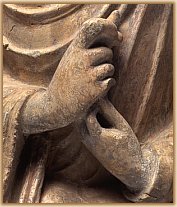
The five are:
Teaching Mudra, Dainichi Nyorai (Vairocana) | Center | White | Well known in Japan.
Fear Not Mudra, Fukūjōju Nyorai (Amoghasiddhi) | North | Green
Welcome Mudra, Hōshō Nyorai (Ratnasambhava) | South | Yellow
Earth-Touching Mudra, Ashuku Nyorai (Akshobhya) | East | Blue
Meditation Mudra, Amida Nyorai (Amitabha) | West | Red | Well known in Japan."
See other well-known mudra are also presented [on Onmarkproductions]
More Info...
The most widely known mudra in Japan are those associated with the Five Buddha of Wisdom (Jp = Godai Nyorai, Gochi Nyorai), a grouping that originated in India, as did most Buddhist iconography. The five are eminations of Buddha nature. They embody five fundamental wisdoms -- wisdom against anger, envy, desire, ignorance, and pride -- to help us break free from the cycle of death and rebirth (samsara). Each of the five has a specific mudra that corresponds to one of the five defining episodes in the life of the Historical Buddha (see charts below). Each of the five is also associated with a compass direction, color, and other attributes. In Japan, only two of the Five Buddha are still widely reverred.
The five are:
Teaching Mudra, Dainichi Nyorai (Vairocana) | Center | White | Well known in Japan.
Fear Not Mudra, Fukūjōju Nyorai (Amoghasiddhi) | North | Green
Welcome Mudra, Hōshō Nyorai (Ratnasambhava) | South | Yellow
Earth-Touching Mudra, Ashuku Nyorai (Akshobhya) | East | Blue
Meditation Mudra, Amida Nyorai (Amitabha) | West | Red | Well known in Japan."
See other well-known mudra are also presented [on Onmarkproductions]
More Info...
Sunday, October 5, 2014
Check out Tiny Buddha (dot) com
In our fast paced, always-on world, it’s not difficult to access information. It comes at you at breakneck speed. Articles, blog posts, status updates, tweets—there’s never a shortage of ideas to consider.
Gaining knowledge isn’t a problem. Applying it, on the other hand, is a lot more challenging, especially when you consider how little time we have throughout our busy days to stop, breathe, and just be.
Tiny Buddha is about reflecting on simple wisdom and learning new ways to apply it to our complex lives—complete with responsibilities, struggles, dreams, and relationships. Over the last four years, Tiny Buddha has emerged as a leading resource for peace and happiness, with more than two million monthly readers.
Lori DescheneMy name is Lori Deschene. Though I run this site, it is not mine. It’s ours. It’s not about me. It’s about us. Your stories and your wisdom are just as meaningful and useful as mine.
The site features tips and authentic stories from readers of all ages all over the globe.
You’ll find posts about happiness, motivation, inspiration, love, relationships, meaning, possibilities, mindfulness, and letting go. Much of it has its roots in Buddhism, but this is not a site about religion. It’s about ideas that make sense and make a big difference when applied.
When you subscribe to Tiny Buddha, you will receive one email each weekday, each including two blog posts. Alternatively, you can choose to receive one weekly digest every Friday.
I invite you to get involved in the site by commenting, sharing a post, or introducing yourself on the Tiny Buddha Facebook page. We’re a really welcoming community! It’s a lot easier to be who you want to be in this world when you remember you are never alone. We are all in this together, and we all have something to teach and something to learn.

For weekly or daily emails, subscribe to the blog.
To seek or offer support from the community, join the free Tiny Buddha forums.
To display a daily quote on your blog, get the Tiny Buddha Quote Widget.
To contribute a post, read the submission guidelines and send your contribution using the form provided, on one of the designated submission days.
To learn more about Tiny Buddha, read the FAQs.....
To learn about Tiny Buddha’s books, products, and courses, visit the Books & Things page.
You can also follow Tiny Buddha on Twitter for a daily quote and links to the site and fan Tiny Buddha on Facebook to share your wisdom with our community.
Thank you for sharing your light. You make a difference, and you’re appreciated.
Check out TinyBuddha
Gaining knowledge isn’t a problem. Applying it, on the other hand, is a lot more challenging, especially when you consider how little time we have throughout our busy days to stop, breathe, and just be.
Tiny Buddha is about reflecting on simple wisdom and learning new ways to apply it to our complex lives—complete with responsibilities, struggles, dreams, and relationships. Over the last four years, Tiny Buddha has emerged as a leading resource for peace and happiness, with more than two million monthly readers.
Lori DescheneMy name is Lori Deschene. Though I run this site, it is not mine. It’s ours. It’s not about me. It’s about us. Your stories and your wisdom are just as meaningful and useful as mine.
The site features tips and authentic stories from readers of all ages all over the globe.
You’ll find posts about happiness, motivation, inspiration, love, relationships, meaning, possibilities, mindfulness, and letting go. Much of it has its roots in Buddhism, but this is not a site about religion. It’s about ideas that make sense and make a big difference when applied.
When you subscribe to Tiny Buddha, you will receive one email each weekday, each including two blog posts. Alternatively, you can choose to receive one weekly digest every Friday.
I invite you to get involved in the site by commenting, sharing a post, or introducing yourself on the Tiny Buddha Facebook page. We’re a really welcoming community! It’s a lot easier to be who you want to be in this world when you remember you are never alone. We are all in this together, and we all have something to teach and something to learn.
For weekly or daily emails, subscribe to the blog.
To seek or offer support from the community, join the free Tiny Buddha forums.
To display a daily quote on your blog, get the Tiny Buddha Quote Widget.
To contribute a post, read the submission guidelines and send your contribution using the form provided, on one of the designated submission days.
To learn more about Tiny Buddha, read the FAQs.....
To learn about Tiny Buddha’s books, products, and courses, visit the Books & Things page.
You can also follow Tiny Buddha on Twitter for a daily quote and links to the site and fan Tiny Buddha on Facebook to share your wisdom with our community.
Thank you for sharing your light. You make a difference, and you’re appreciated.
Check out TinyBuddha
Monday, July 28, 2014
Tridosha's Doshas in Ayurvedic Medicine
"Ayurveda, ancient medical/holistic system from the vedic civilization of India, teaches that health is maintained by the balancing of three subtle energies known as Doshas - individually they are Vatha, Pitta and Kapha.
This system teaches maintenance and protection of the whole person (mind, body and soul). Ayurvedic medicine is based on an individual's characteristics and body frame rather than oriented toward treating disease or sickness.
Each of us are made up of a combination of the three types of doshas. The three doshas are comprised of these five universal elements:
Vatha is a combination of air and space.
Pitta is mostly fire with some water.
Kapha is mostly water with some earth.
Overall well-being and striving for longevity depends on keeping your doshas balanced. Any imbalance among the tridoshas causes a state of unhealthiness or disease. Factors that can bring about balance of the tridoshas are diet, exercise, good digestion, and elimination of toxins. You can follow the three links below to evaluate the characteristics of each dosha to consider if you are predominately one dosha or would be classified as a combo-energy such as vatha-pitta or vatha-kapha, or pitta-kapha, and so on. "
See more about Ayurveda and vatta,pitta, etc @ About (dot) com
This system teaches maintenance and protection of the whole person (mind, body and soul). Ayurvedic medicine is based on an individual's characteristics and body frame rather than oriented toward treating disease or sickness.
Each of us are made up of a combination of the three types of doshas. The three doshas are comprised of these five universal elements:
- space
- air
- earth
- fire
- water
Vatha is a combination of air and space.
Pitta is mostly fire with some water.
Kapha is mostly water with some earth.
Overall well-being and striving for longevity depends on keeping your doshas balanced. Any imbalance among the tridoshas causes a state of unhealthiness or disease. Factors that can bring about balance of the tridoshas are diet, exercise, good digestion, and elimination of toxins. You can follow the three links below to evaluate the characteristics of each dosha to consider if you are predominately one dosha or would be classified as a combo-energy such as vatha-pitta or vatha-kapha, or pitta-kapha, and so on. "
See more about Ayurveda and vatta,pitta, etc @ About (dot) com
Monday, July 21, 2014
Who is Alan Watts?

"Worldview
Alan Watts was profoundly influenced by the East Indian philosophies of Vedanta and Buddhism, and by Taoist thought, which is reflected in Zen poetry and the arts of China and Japan. After leaving the Church he never became a member of another organized religion, although he wrote and spoke extensively about Zen Buddhism, Hinduism, and Taoisim. Some American Buddhists criticized him for not sitting regularly in zazen, even though he recorded several guided meditations teaching a variety of mediation techniques. Alan Watts responded simply by saying: “A cat sits until it is done sitting, and then gets up, stretches, and walks away.”"
More Info..
Religious Tolerance (dot) org
"The importance of faith/belief statements:
We feel that every denomination, para-church organization, religious group, and religious web site should consider creating a statement of belief or faith and displaying it prominently. This is particularly important among Christian groups who may use the term "Christian" to refer to only the Roman Catholic Church, or only to Evangelical Protestantism, or to the full range of Christian denominations and beliefs, or to some other subset of the religion. Quite often, when we visit a Christian web site for the first time, we have to search around among its articles to find out exactly what Christian belief system they follow and promote on their web site.
That said, the following is our attempt at a statement of belief. Please be sure to read the footnotes at the bottom of the essay because they include some important qualifications and exceptions.
OCRT Statement of Belief:
We are a multi-faith group. As of late-2012, we consist of one Atheist, Agnostic, Christian, Wiccan and Zen Buddhist. Thus, the OCRT staff lack agreement on almost all theological matters, such as belief in a supreme being, the nature of God, interpretation of the Bible and other holy texts, whether life after death exists, what form the afterlife may take, etc.
We believe in:
Personal worth: The inherent worth of every person. People are worthy of respect, support, and caring simply because they are human. Unfortunately, our group has not reached a consensus on when human life, in the form of an ovum and spermatozoon, becomes a human person with civil rights including the right to live. On this matter, our group's lack of agreement on when personhood begins mirrors that of society at large.
Lack of discrimination: Working towards a culture that is relatively free of discrimination on the basis of gender, race, sexual orientation, gender identity, religion, national origin, physical disability, language, age, body shape, etc.
Dignity: The dignity of the human person. We oppose the use of torture and cruel or unusual punishment including the death penalty.
Democracy: The importance of democratic processes within religious, political, and other structures in which the will of the people is implemented, subject to the limits imposed by the constitution.
Religion-state matters: The separation of religion and the state. (This is generally referred to as "separation of church and state." But we prefer the more inclusive term). The government should avoid promoting one faith group within a religion over another, or promote one religion over another, promote religion over secular beliefs, or promote secular beliefs over religion. 1
Personal freedom: The freedoms of religious beliefs, speech, association, and expression at the individual, congregational and denominational level. 1
Freedom of speech: The freedom to compare the beliefs of faith groups with each other, and with the findings of science. It also includes the freedom to criticize faith and other groups when they harm others.
Relative truth: The principle that many moral, ethical, and religious beliefs vary greatly from one culture, religion, and time to another, and are thus relative. We do acknowledge that they are often considered absolute by various religions and secular belief systems. 2
Impact of religion: The generally positive influence that most religions have had on their followers and on society. 3
A problem with the use of prayer: It is our belief that prayer is an unreliable method to assess the will of God. We were initially divided on this matter, but a pilot study appears to indicate that prayer for this purpose is unreliable.
Evil in religion: In the importance of individual believers detecting evil influences and policies that currently exist within their chosen faith group, and strongly advocating for their correction. If significant improvement or elimination of sexism, racism, homophobia, transphobia, xenophobia, etc. is impossible, we feel that they should consider withholding financial support and/or leaving the group. 4
Education: The principle that people are not truly educated unless they have studied the world's major religions and ethical systems. They need to learn of both the good and evil impacts that each has had on society throughout history. They need to be taught skills at analysis and "baloney detection." 5
Check out Religious Tolerance (dot) org
We feel that every denomination, para-church organization, religious group, and religious web site should consider creating a statement of belief or faith and displaying it prominently. This is particularly important among Christian groups who may use the term "Christian" to refer to only the Roman Catholic Church, or only to Evangelical Protestantism, or to the full range of Christian denominations and beliefs, or to some other subset of the religion. Quite often, when we visit a Christian web site for the first time, we have to search around among its articles to find out exactly what Christian belief system they follow and promote on their web site.
That said, the following is our attempt at a statement of belief. Please be sure to read the footnotes at the bottom of the essay because they include some important qualifications and exceptions.
OCRT Statement of Belief:
We are a multi-faith group. As of late-2012, we consist of one Atheist, Agnostic, Christian, Wiccan and Zen Buddhist. Thus, the OCRT staff lack agreement on almost all theological matters, such as belief in a supreme being, the nature of God, interpretation of the Bible and other holy texts, whether life after death exists, what form the afterlife may take, etc.
We believe in:
Personal worth: The inherent worth of every person. People are worthy of respect, support, and caring simply because they are human. Unfortunately, our group has not reached a consensus on when human life, in the form of an ovum and spermatozoon, becomes a human person with civil rights including the right to live. On this matter, our group's lack of agreement on when personhood begins mirrors that of society at large.
Lack of discrimination: Working towards a culture that is relatively free of discrimination on the basis of gender, race, sexual orientation, gender identity, religion, national origin, physical disability, language, age, body shape, etc.
Dignity: The dignity of the human person. We oppose the use of torture and cruel or unusual punishment including the death penalty.
Democracy: The importance of democratic processes within religious, political, and other structures in which the will of the people is implemented, subject to the limits imposed by the constitution.
Religion-state matters: The separation of religion and the state. (This is generally referred to as "separation of church and state." But we prefer the more inclusive term). The government should avoid promoting one faith group within a religion over another, or promote one religion over another, promote religion over secular beliefs, or promote secular beliefs over religion. 1
Personal freedom: The freedoms of religious beliefs, speech, association, and expression at the individual, congregational and denominational level. 1
Freedom of speech: The freedom to compare the beliefs of faith groups with each other, and with the findings of science. It also includes the freedom to criticize faith and other groups when they harm others.
Relative truth: The principle that many moral, ethical, and religious beliefs vary greatly from one culture, religion, and time to another, and are thus relative. We do acknowledge that they are often considered absolute by various religions and secular belief systems. 2
Impact of religion: The generally positive influence that most religions have had on their followers and on society. 3
A problem with the use of prayer: It is our belief that prayer is an unreliable method to assess the will of God. We were initially divided on this matter, but a pilot study appears to indicate that prayer for this purpose is unreliable.
Evil in religion: In the importance of individual believers detecting evil influences and policies that currently exist within their chosen faith group, and strongly advocating for their correction. If significant improvement or elimination of sexism, racism, homophobia, transphobia, xenophobia, etc. is impossible, we feel that they should consider withholding financial support and/or leaving the group. 4
Education: The principle that people are not truly educated unless they have studied the world's major religions and ethical systems. They need to learn of both the good and evil impacts that each has had on society throughout history. They need to be taught skills at analysis and "baloney detection." 5
Check out Religious Tolerance (dot) org
Tuesday, July 15, 2014
Thursday, July 10, 2014
Who is Shunryu Suzuki?
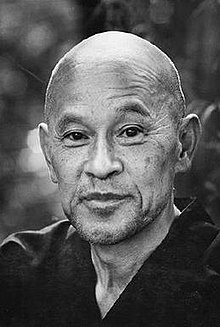
"Shunryu Suzuki (鈴木 俊隆 Suzuki Shunryū, dharma name Shōgaku Shunryū 祥岳俊隆, often called Suzuki Roshi) (born May 18, 1904, Kanagawa Prefecture of Japan; died December 4, 1971 in San Francisco, CA, USA) was a Sōtō Zen monk and teacher who helped popularize Zen Buddhism in the United States, and is renowned for founding the first Buddhist monastery outside Asia (Tassajara Zen Mountain Center). Suzuki founded San Francisco Zen Center, which along with its affiliate temples, comprises one of the most influential Zen organizations in the United States. A book of his teachings, Zen Mind, Beginner's Mind, is one of the most popular books on Zen and Buddhism in the West"
See more at Wikipedia
Subscribe to:
Posts (Atom)