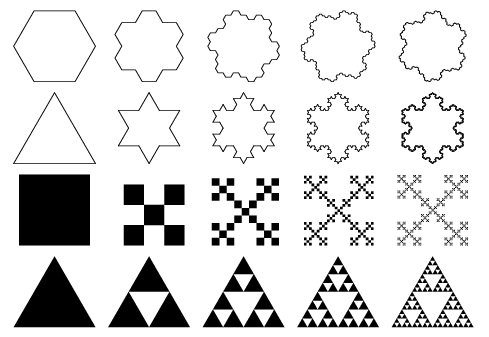
"Back in the 1960's, a French mathematician named Benoit Mandelbrot started thinking about simple pretty simple: How long is the coast of Britain? Sure, it seems easy enough... But, think about how you'd really measure it... Would you fly over the coast in an airplane and measure how far you flew? Or would you take a ruler (or meter stick) and get down on your hands and knees and crawl around the edge? It would be different!
In 1975, he made up the word "fractal" because he thought these figures would look fractured or broken up. It wasn't until he had a computer that he could SEE a picture of what he'd been thinking about!"
See more
@Math Is Fun!

"A fractal is a geometric shape which is self-similar and has fractional (fractal) dimension.....
Fractal geometry and chaos theory are providing us with a new perspective to view the world. For centuries we've used the line as a basic building block to understand the objects around us. Chaos science uses a different geometry called fractal geometry. Fractal geometry is a new language used to describe, model and analyze complex forms found in nature.
A few things that fractals can model are:
plants
weather
fluid flow
geologic activity
planetary orbits
human body rhythms
animal group behavior
socioeconomic patterns
music
and more ...
This is how nature creates a magnificent tree from a seed the size of a pea ... or broccoflower
Fractal dimension can measure the texture and complexity of everything from coastlines to mountains to storm clouds. We can now use fractals to store photographic quality images in a tiny fraction of the space ordinarily needed.
Fractals win prizes at graphics shows and appear on tee - shirts and calanders. Their chaotic patterns appear in many branches of science. Physicists find them on their plotters. Strange attractors with Fractal turbulence appear in celestial mechanics. Biologists diagnose dynamical diseases. Even pure mathematicians such as Bob Devaney, Heinz-Otto Peitgen and Richard Voss go on tour with slide shows and videos of their research.
Fractals provide a different way of observing and modeling complex phenomena than Euclidean Geometry or the Calculus developed by Leibnitz and Newton. An arising cross disciplinary science of complexity coupled with the power of desktop computers brings new tools and techniques for studying real world systems."
See more
@Math at Umass
More info...
Fractals at Yale page
Math World